

Accessible summary
What this session covers
This enhanced session explains how to design a focused Copilot agent for a repeated, low-risk knowledge need. It covers purpose, audience, boundaries, instructions, starter prompts, trusted web sources, three-part testing, refinement and proportionate ownership after sharing.
- choosing a suitable repeated knowledge need
- deciding whether one prompt or a reusable agent fits the pattern
- writing a narrow one-sentence purpose
- defining audience, boundaries and onward routes
- writing instructions and a recognisable response pattern
- using starter prompts to show intended use
- adding approved, current web sources
- testing normal, ambiguous and out-of-scope questions
- refining the instruction or source that caused the behaviour
- assigning an owner, source review and feedback route
Making the session work for you
The session is delivered through a Microsoft Teams webinar using PowerPoint Live. You can personalise how you follow and take part. The session is recorded, and you can watch rather than follow along unless the trainer asks you to try something.
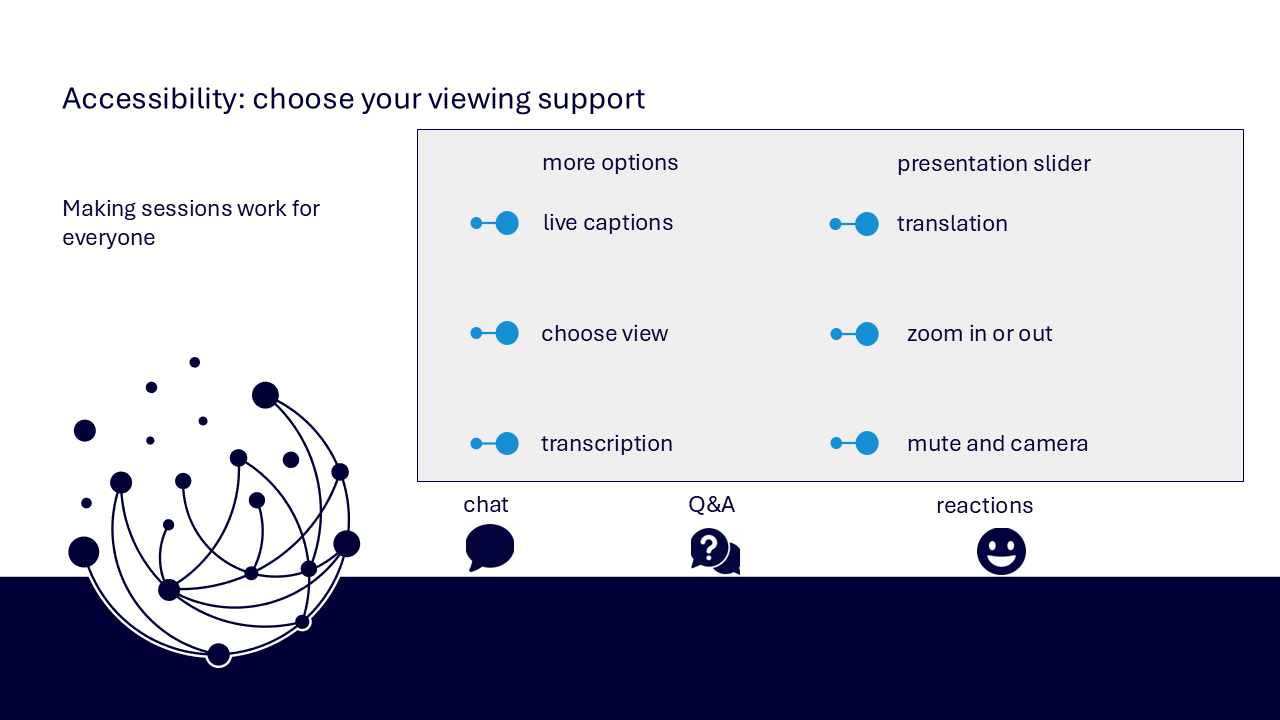
- use live captions or translation from the three-dots menu
- choose a view that gives you the clearest layout
- use the presentation slider to zoom in or out
- keep your camera and microphone off unless invited
- use Q&A for questions and keep chat closed when not typing
- use reactions or another participation route if that works better for you
- share respectful feedback and use the key links provided in chat
Everyone can build confidence
The aim is to prove one narrow use case before adding topics or audiences. A focused promise is easier for users to understand, and easier for an owner to test and maintain.
Navigator and WeChange.AI
Navigator is a personalised platform for WeChange.AI customers. It helps you find Microsoft 365 tools, resources and upcoming sessions relevant to your role.
WeChange.AI supports public and third sector organisations to use technology with confidence, purpose and impact.
Key concepts
The challenge
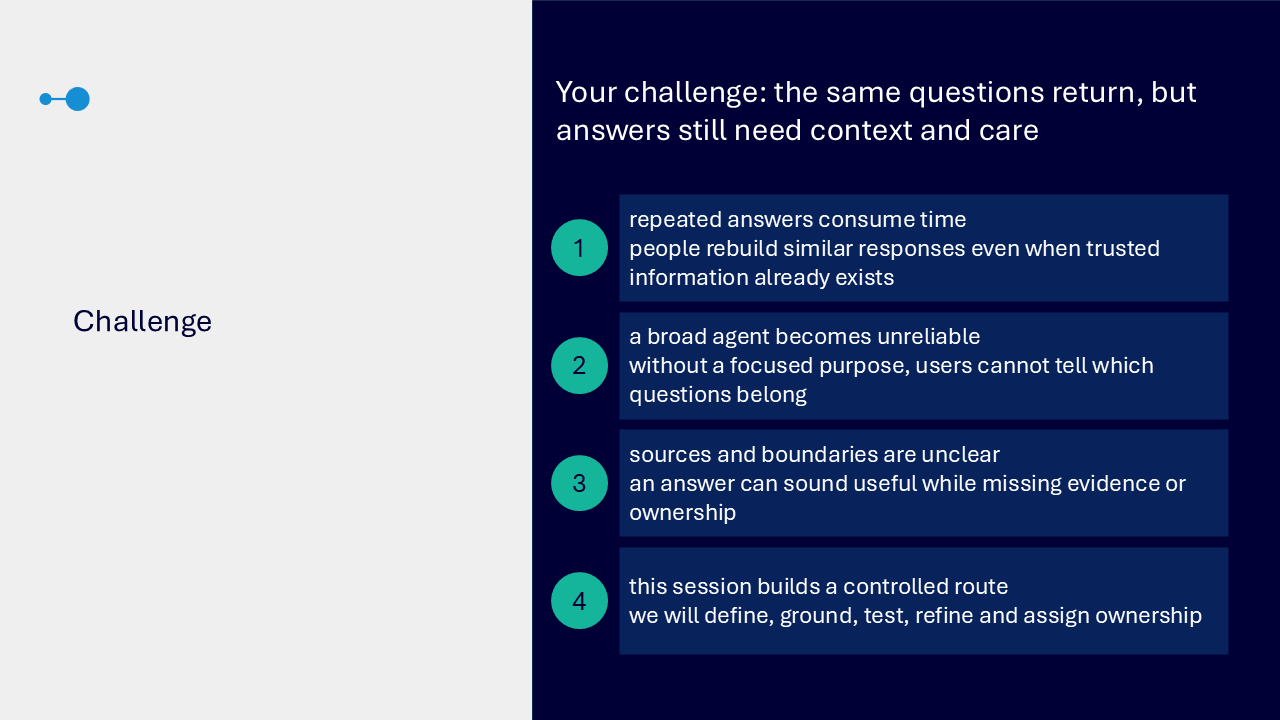
Repeated answers consume time even when trusted information already exists. A broad agent becomes difficult to explain and unreliable to use. Unclear sources and boundaries can produce plausible answers without enough evidence or ownership. The session builds a controlled route through definition, grounding, testing, refinement and review.
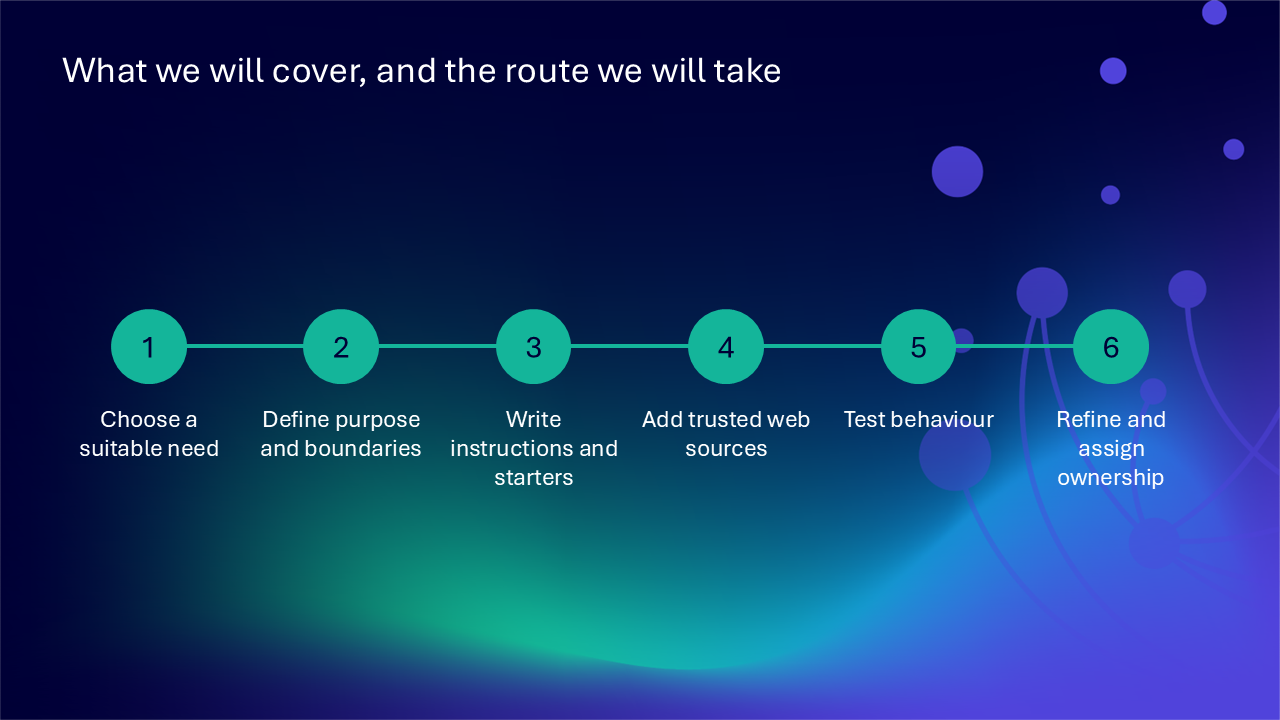
Your route through the session
- choose a suitable need
- define purpose and boundaries
- write instructions and starters
- add trusted web sources
- test behaviour
- refine and assign ownership
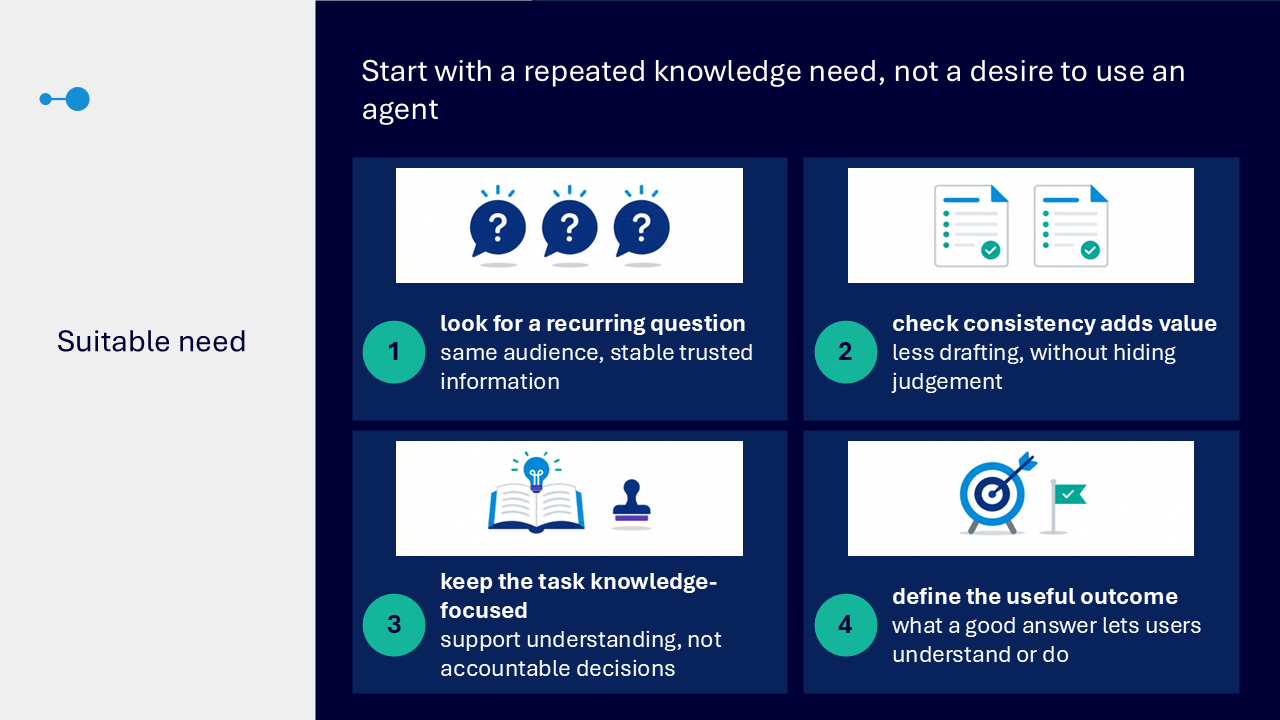
Start with a repeated knowledge need
- look for a recurring question from the same audience
- check that consistent answers add value without hiding necessary judgement
- keep the task focused on knowledge and understanding
- name what a useful answer lets the user understand or do
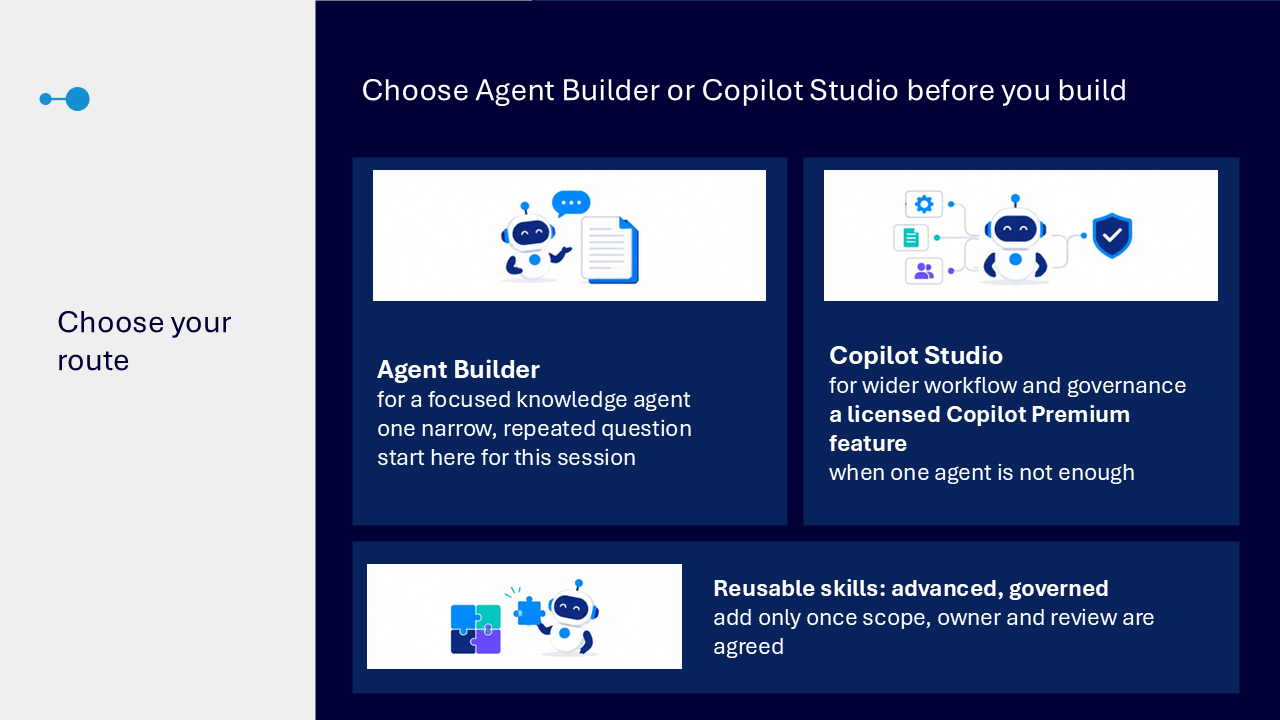
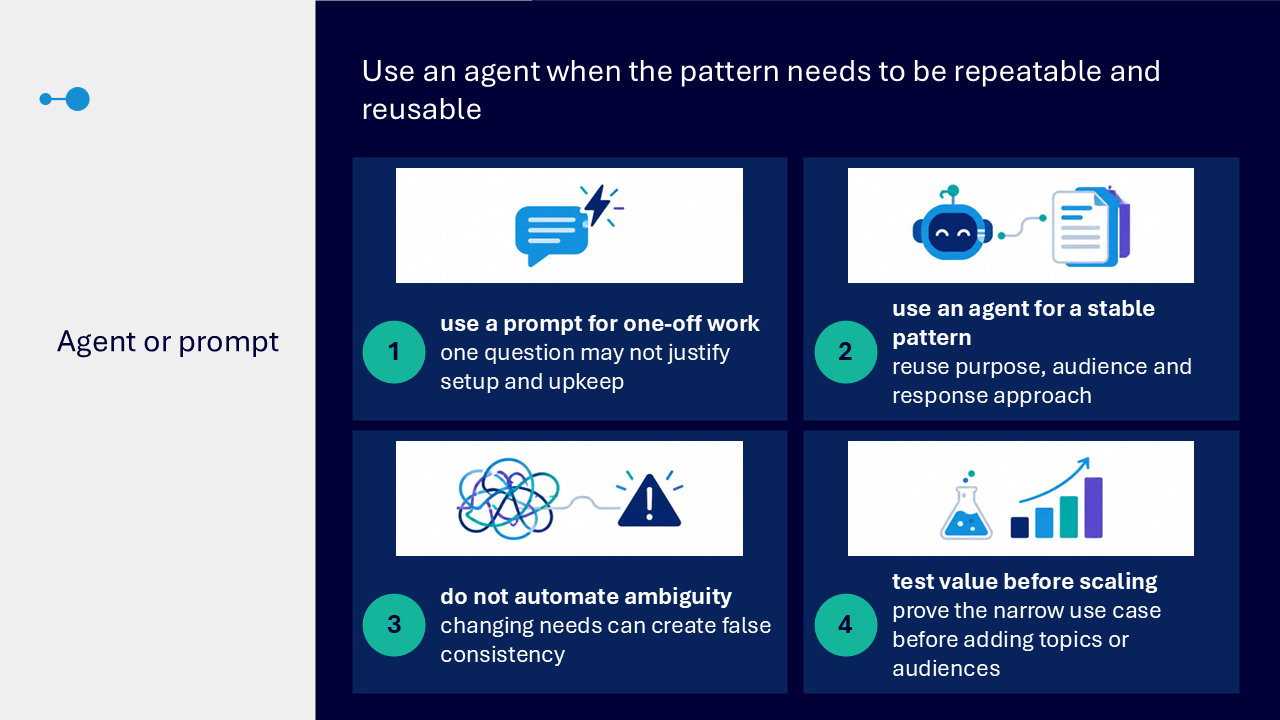
Choose between a prompt and an agent
- use a prompt for one-off work
- use an agent when purpose, audience and response approach need to be reused
- do not automate ambiguity or a rapidly changing need
- prove the narrow use case before scaling
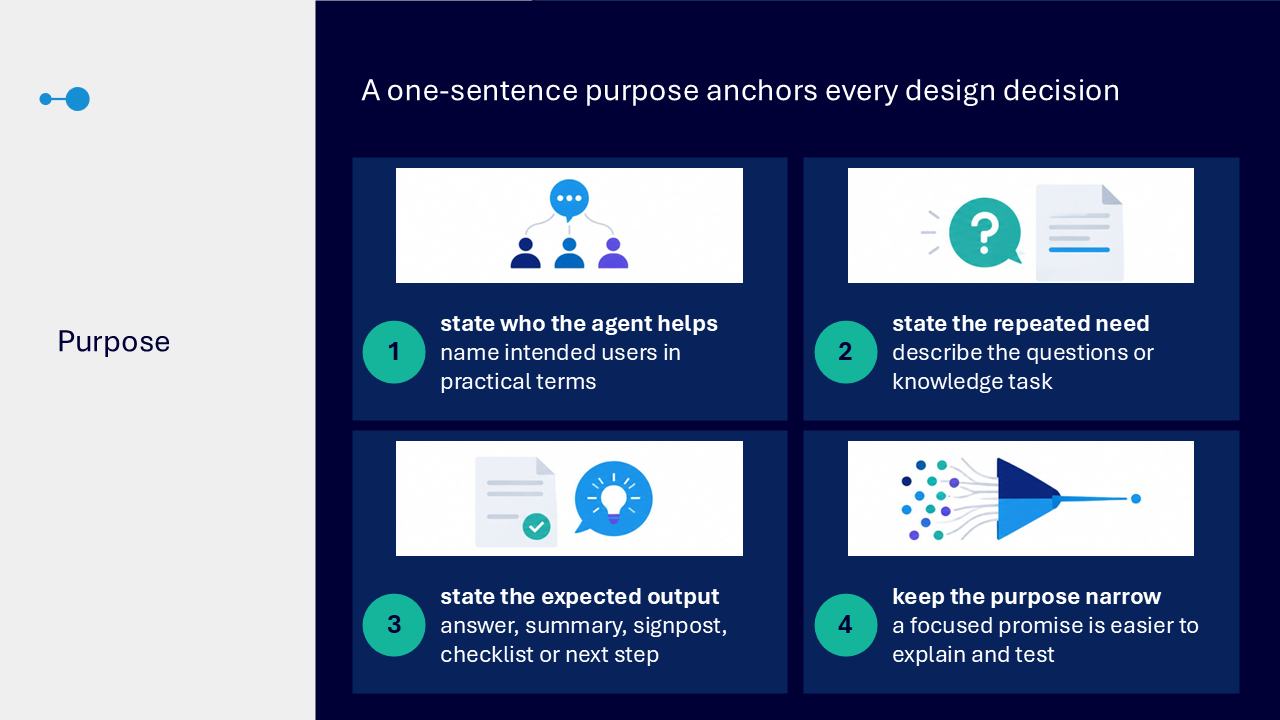
Write a one-sentence purpose
- state who the agent helps
- state the repeated question or knowledge task
- state the expected output, such as an answer, summary, signpost or checklist
- keep the promise narrow enough to explain and test
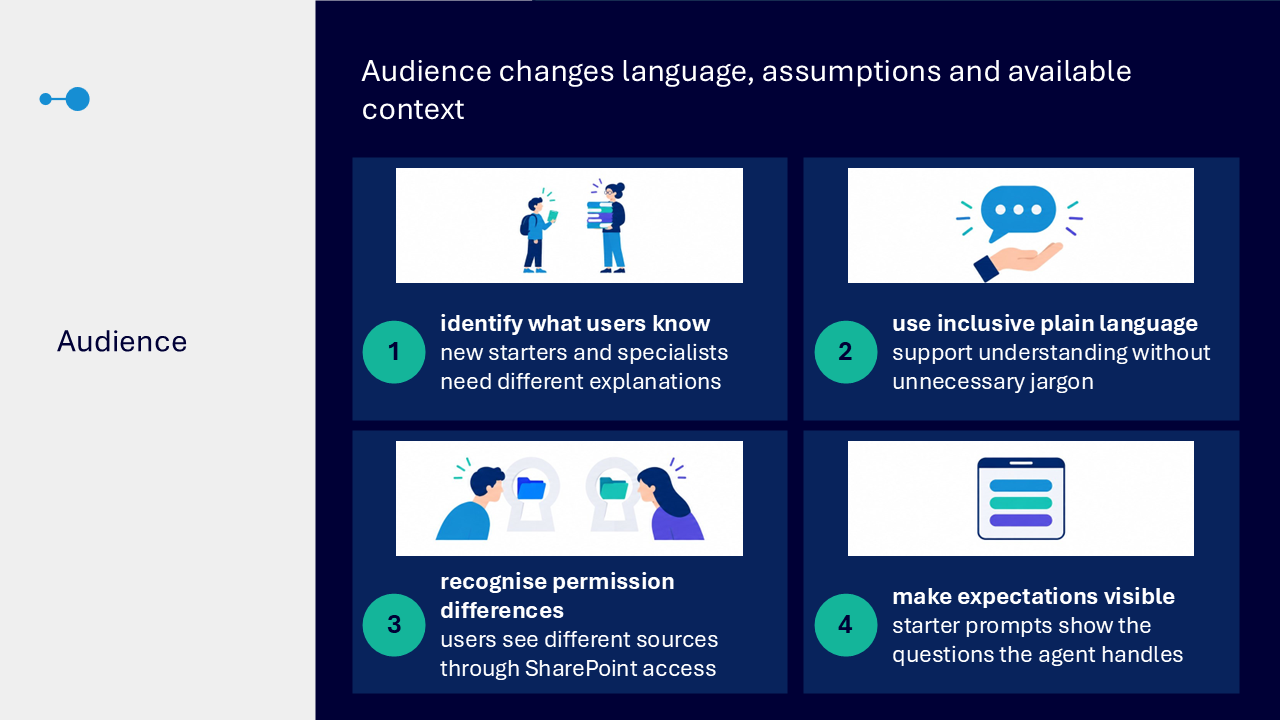
Define the audience
- identify what intended users are likely to know
- use inclusive plain language without unnecessary jargon
- recognise that users may have different access to source content
- use starter prompts to make expectations visible
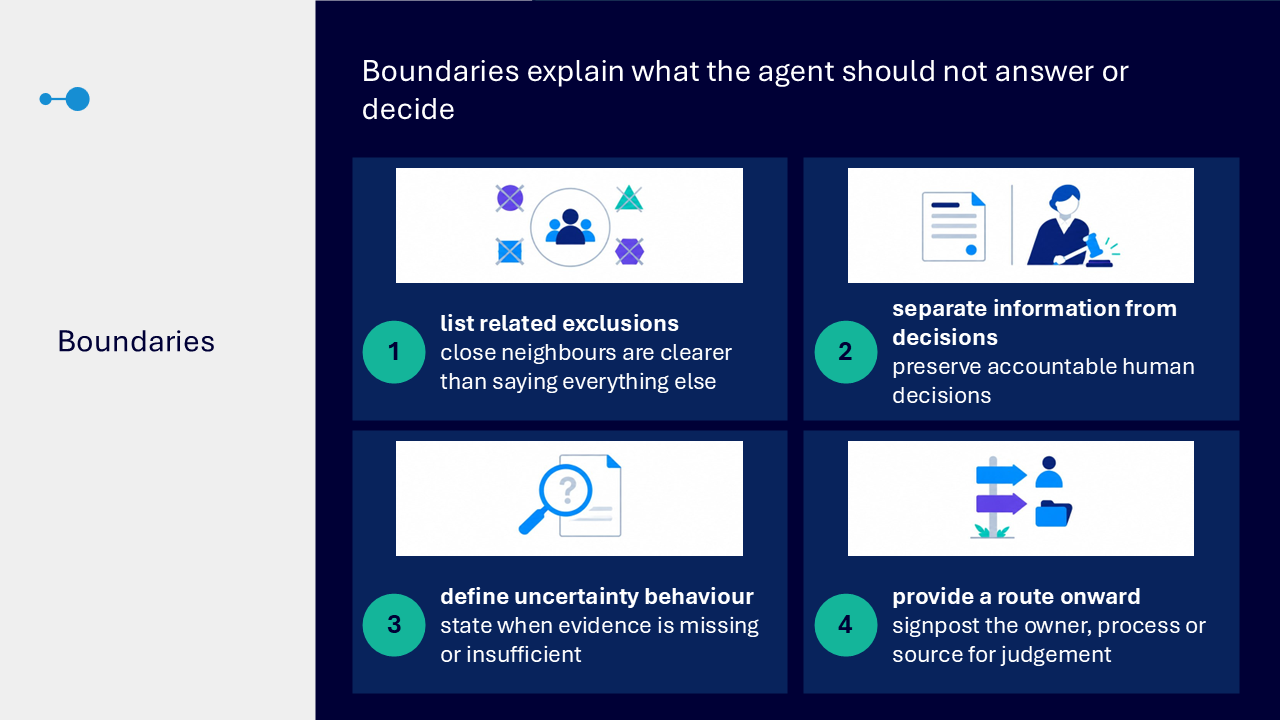
Set firm boundaries
- name related questions the agent should not handle
- separate information support from accountable decisions
- state when evidence is missing or insufficient
- signpost the correct owner, process or source for judgement
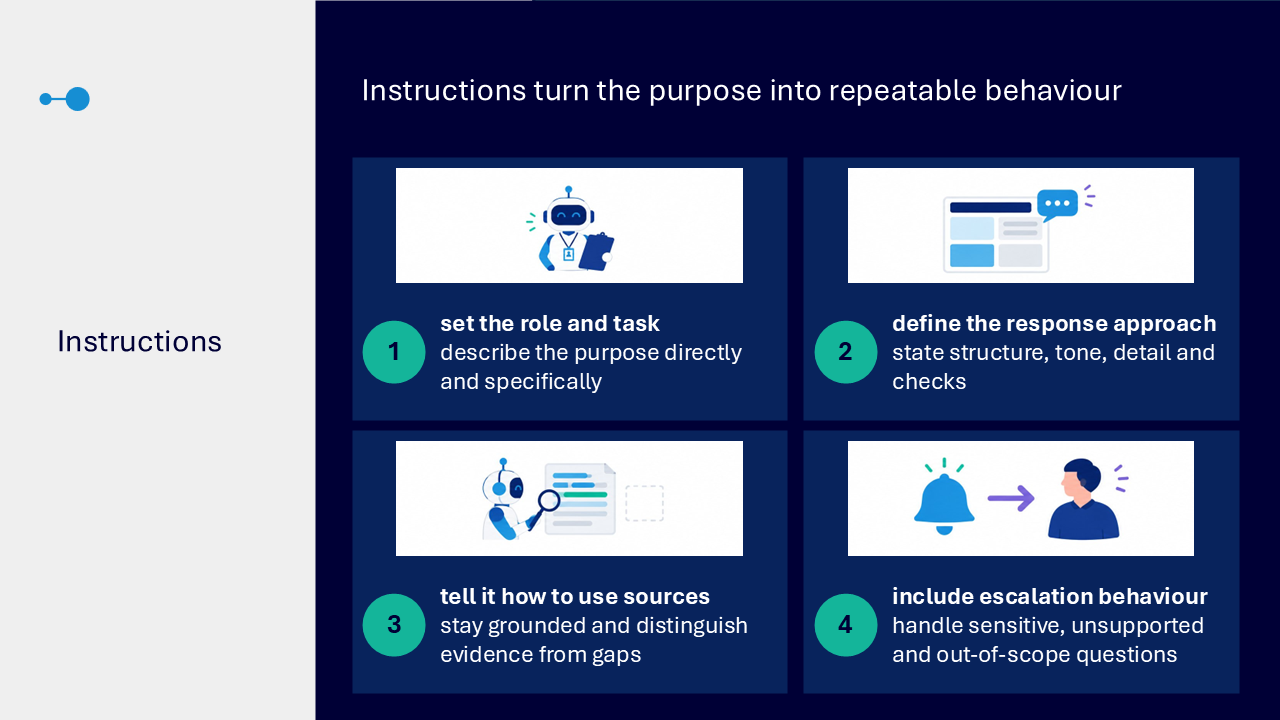
Write instructions for repeatable behaviour
- describe the role and task directly
- state the response structure, tone, detail and checks
- tell the agent to stay grounded in sources and identify gaps
- include behaviour for sensitive, unsupported or out-of-scope questions
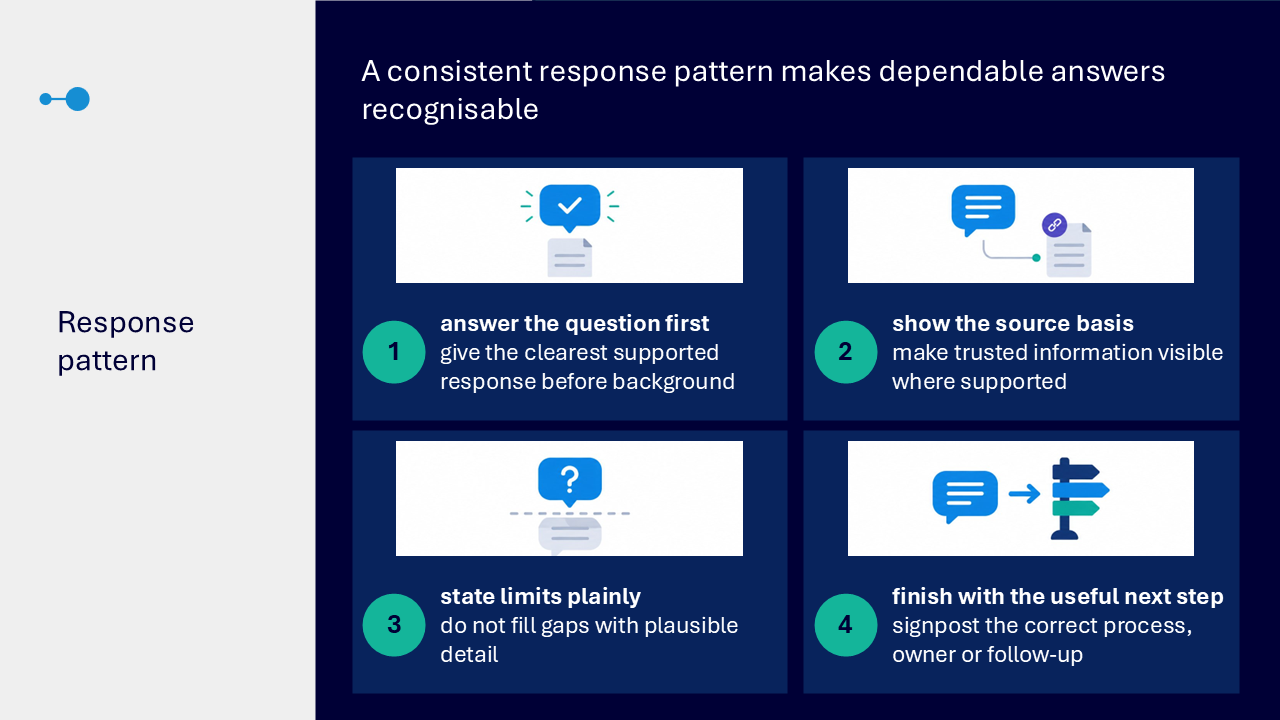
Use a consistent response pattern
- answer the question first
- show the source basis where supported
- state limits plainly instead of filling gaps
- finish with the useful next step or signpost
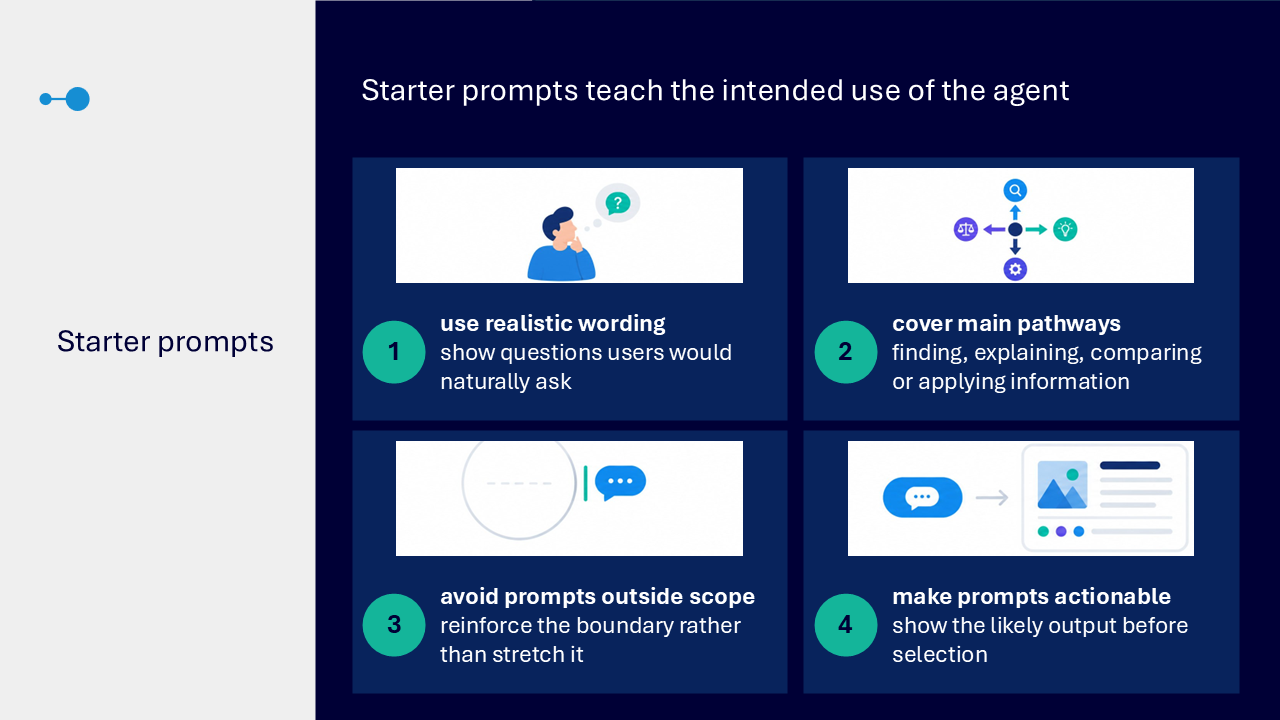
Use starter prompts to teach intended use
- use realistic wording users would naturally choose
- cover main pathways such as finding, explaining, comparing or applying information
- avoid examples that stretch the agent beyond scope
- show the likely output before a prompt is selected
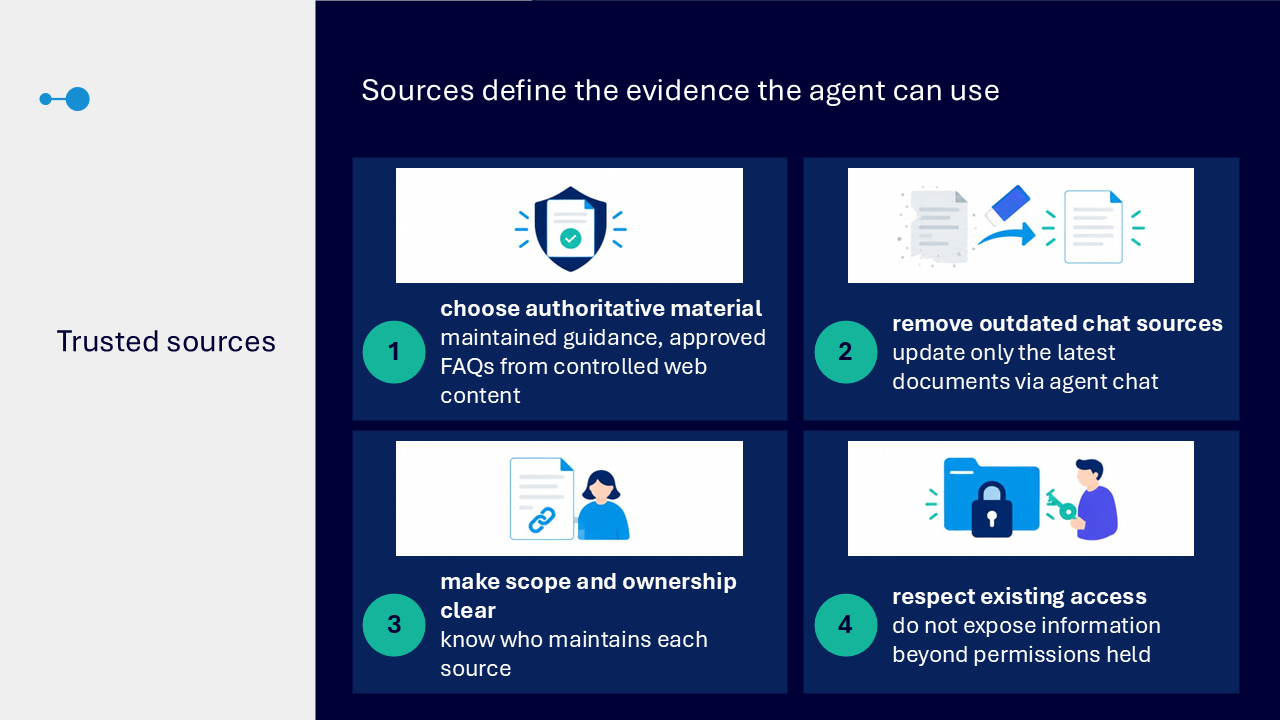
Choose trusted sources
- use maintained guidance, approved frequently asked questions and controlled web content
- remove or replace outdated source material
- make source scope and ownership clear
- respect existing access permissions
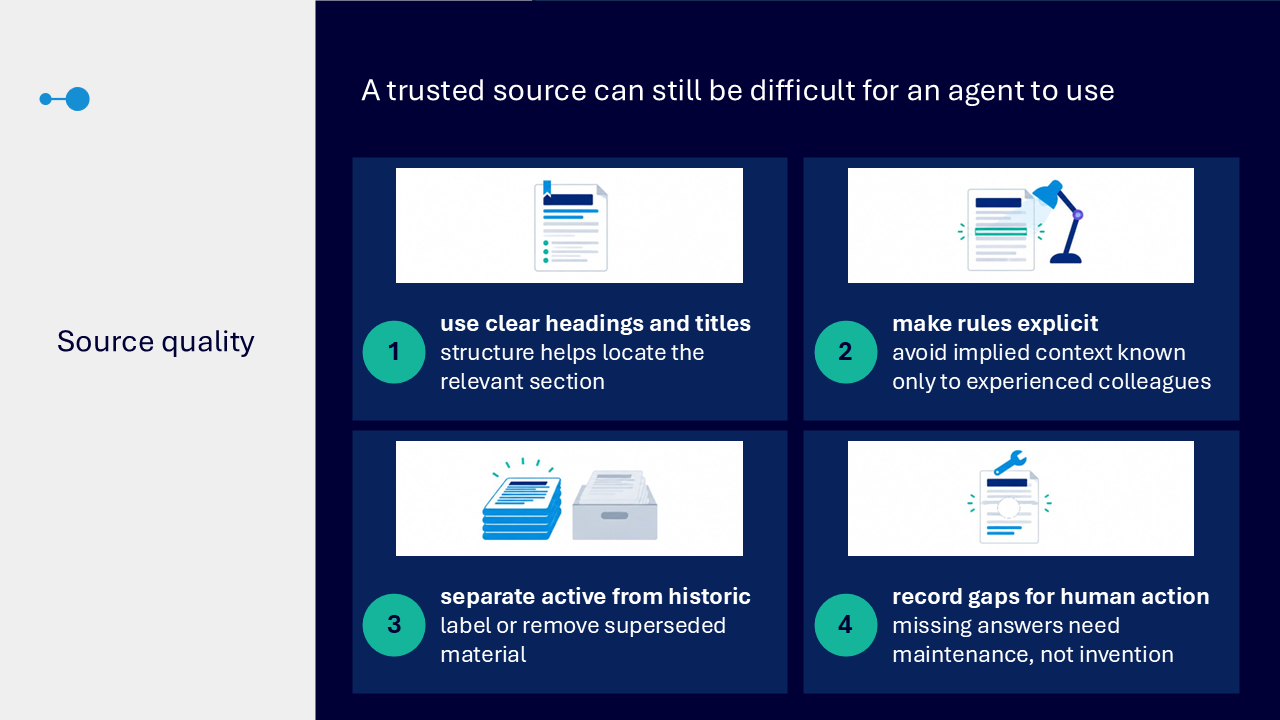
Improve source quality
- use clear headings and titles
- make rules explicit rather than relying on experienced colleagues’ implied context
- separate active guidance from historic material
- record missing answers for human maintenance rather than invention
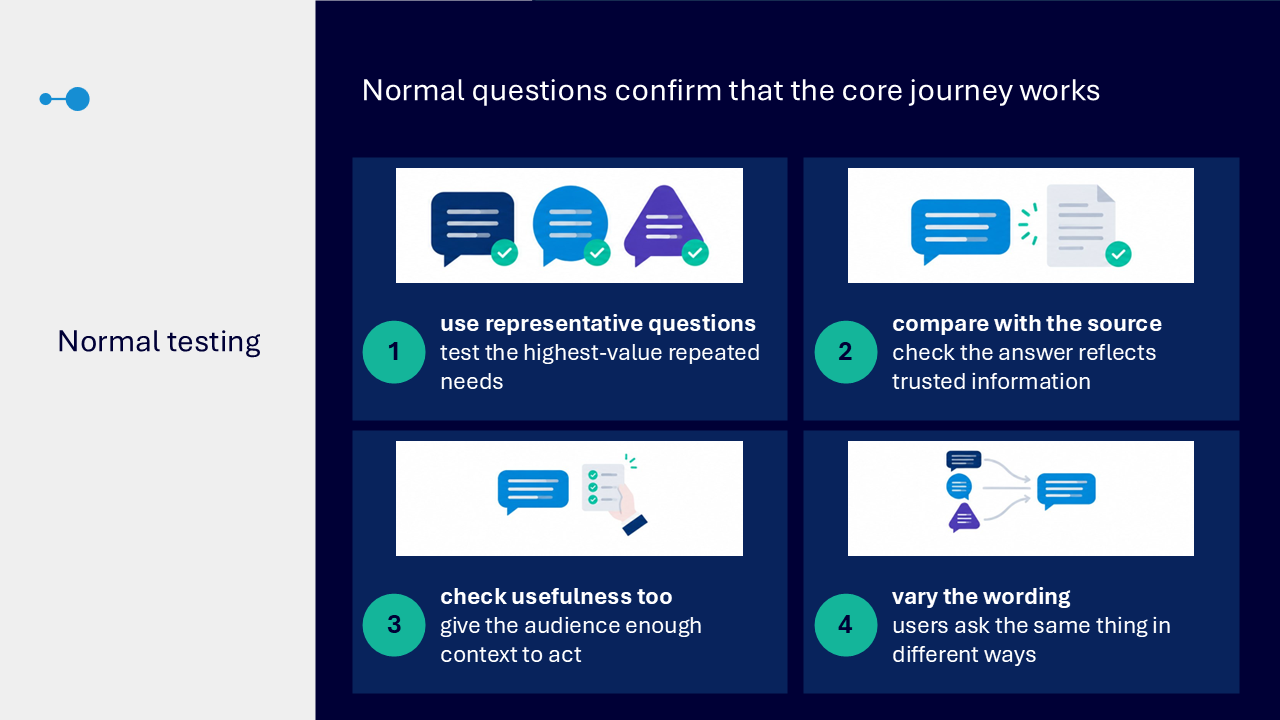
Test normal questions
- use representative high-value questions
- compare answers with the source
- check that the audience receives enough context to act
- vary the wording because users ask the same thing differently
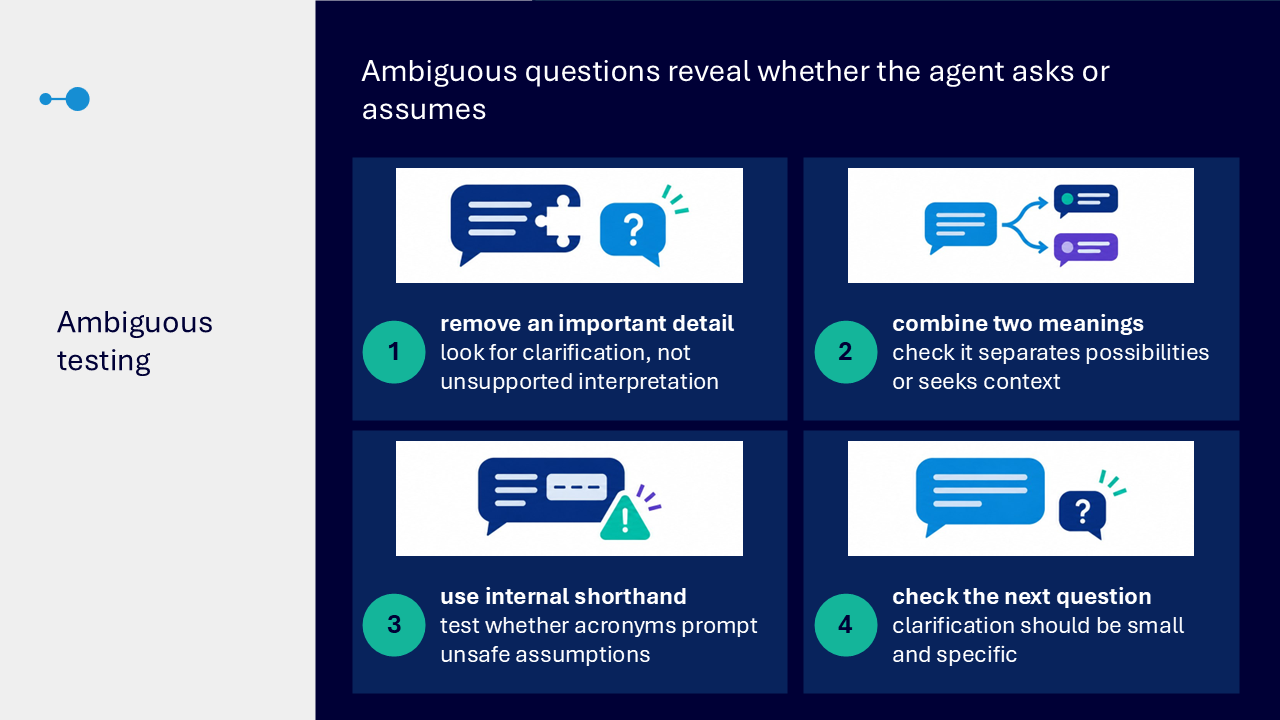
Test ambiguous questions
- remove an important detail and look for clarification
- combine two meanings and check that possibilities are separated
- use internal shorthand to test unsafe assumptions
- check that any clarification question is small and specific
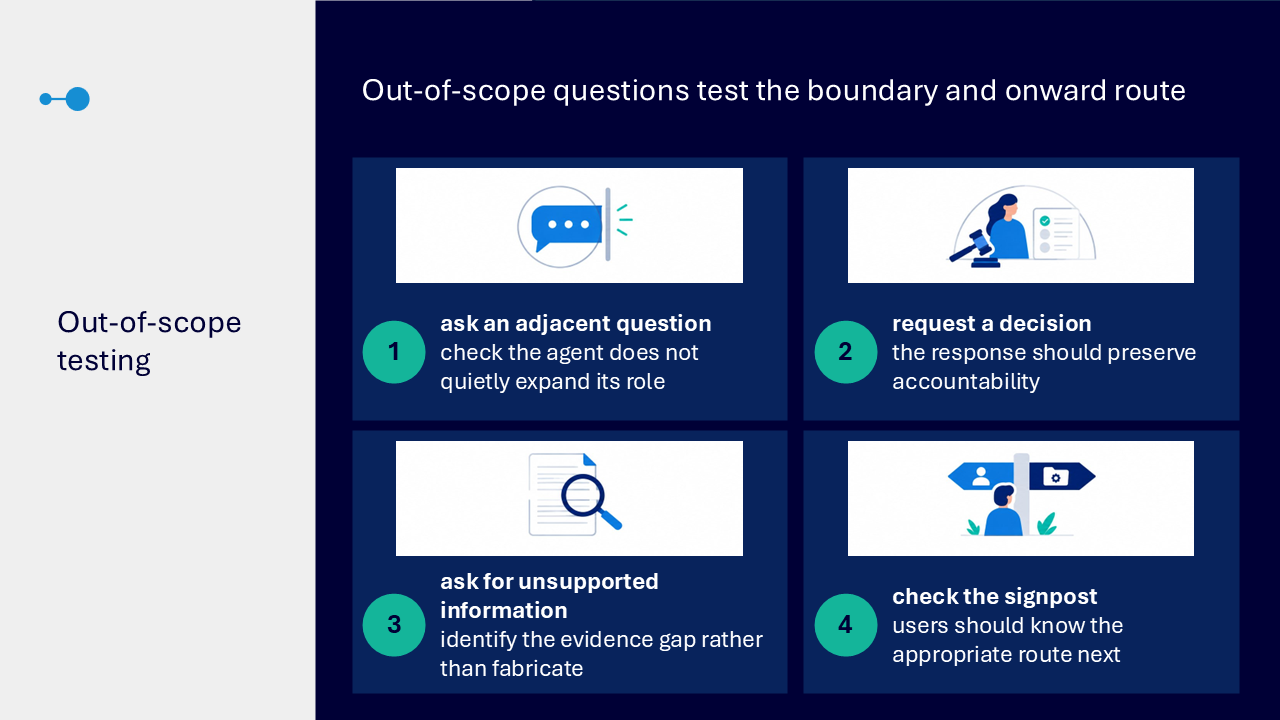
Test out-of-scope questions
- ask an adjacent question and check that the role does not quietly expand
- request a decision and check that accountability is preserved
- ask for unsupported information and look for an evidence gap rather than fabrication
- check that the onward route is clear
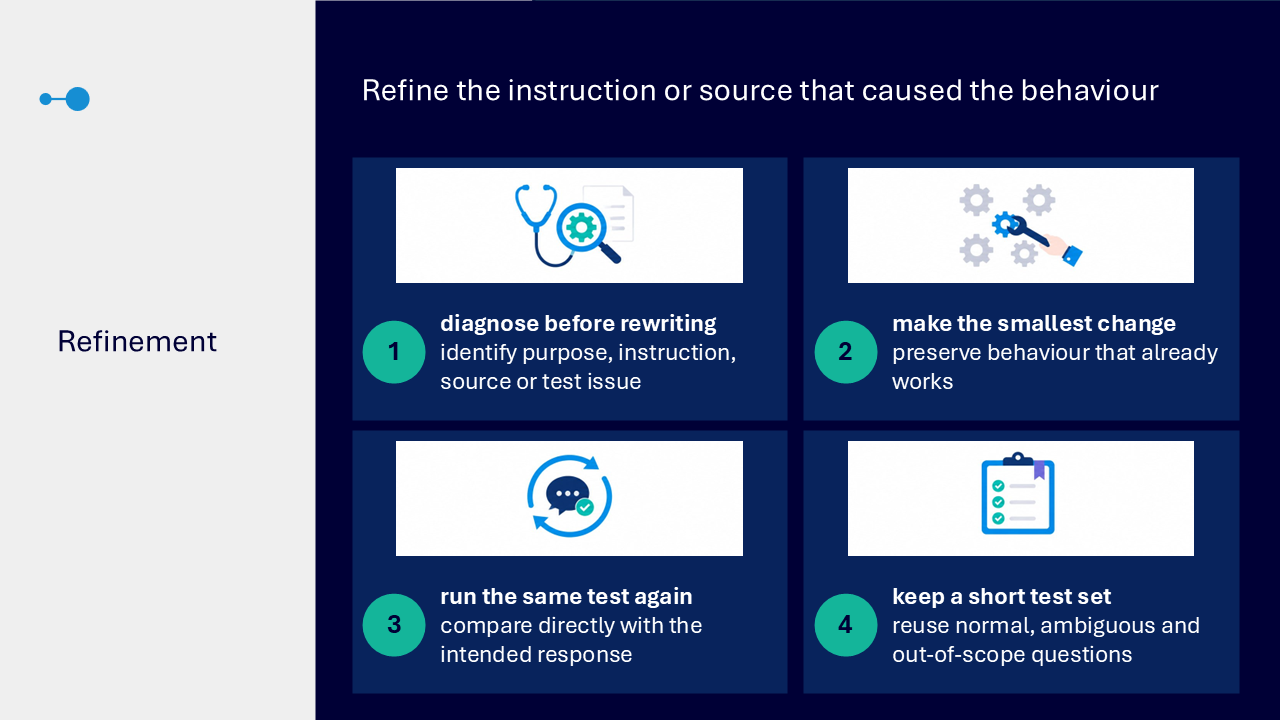
Refine one thing at a time
- diagnose whether the cause is purpose, instruction, source or test design
- make the smallest change that addresses the problem
- run the same question again
- keep a short reusable set of normal, ambiguous and out-of-scope tests
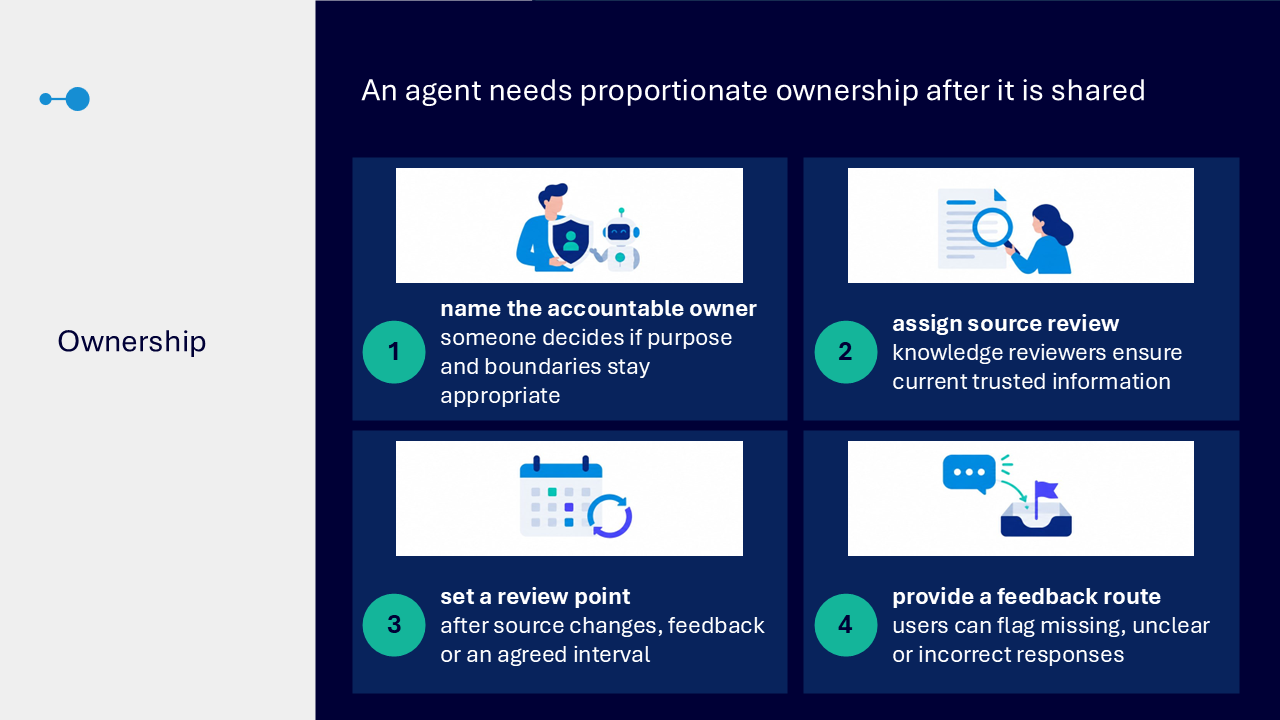
Assign proportionate ownership
- name an accountable owner for purpose and boundaries
- assign people to review the source knowledge
- set a review point after source changes, feedback or an agreed interval
- provide a route for users to flag missing, unclear or incorrect responses
What the visuals and demonstrations showed
The visual sequence followed one agent from a repeated question to an owned and reviewable service.
- comparing a one-off prompt with a reusable agent
- writing the audience, repeated need and output in one purpose statement
- naming related exclusions and routes onward
- turning the purpose into instructions and a response pattern
- creating realistic starter prompts
- selecting current, maintained sources
- reviewing source structure and gaps
- testing normal questions with varied wording
- testing ambiguity and internal shorthand
- testing adjacent, unsupported and decision requests
- diagnosing behaviour and making the smallest change
- assigning ownership and a feedback route
Key takeaways
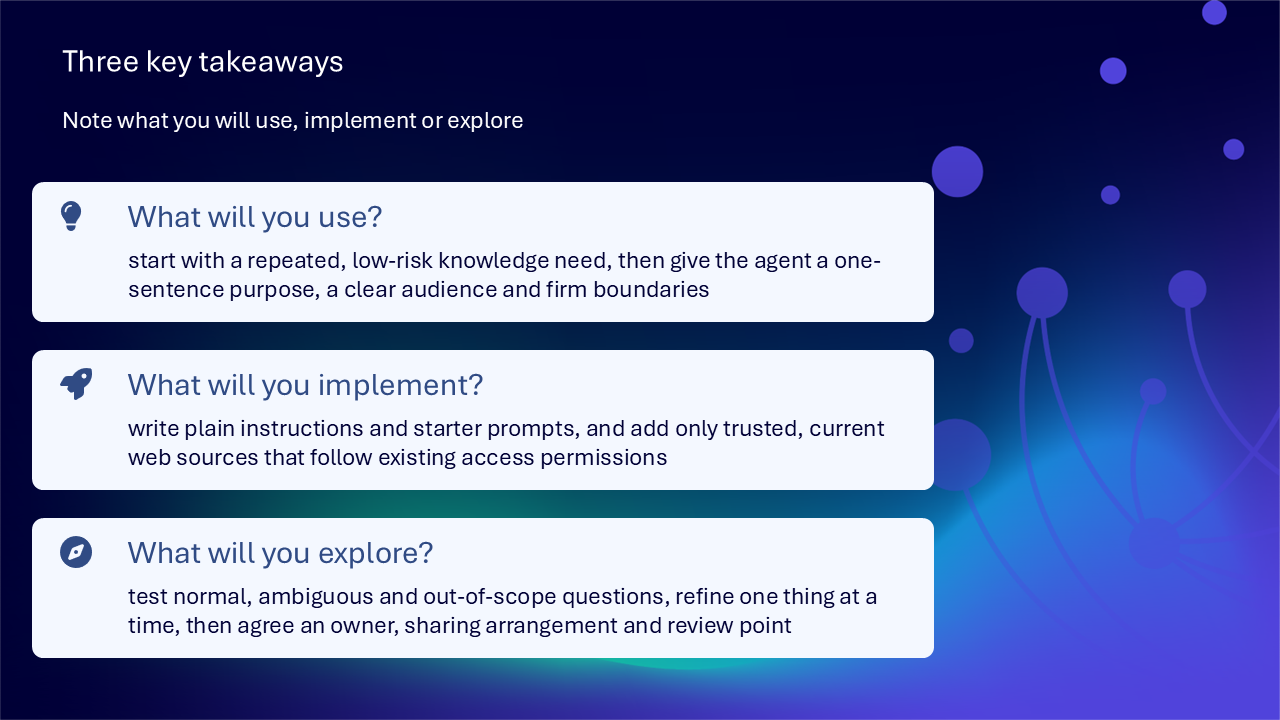
- start with a repeated, low-risk knowledge need
- give the agent a one-sentence purpose and clear audience
- state boundaries and preserve accountable decisions
- write plain instructions and realistic starter prompts
- use only trusted, current sources
- test normal, ambiguous and out-of-scope questions
- refine one cause at a time
- agree ownership, sharing and review
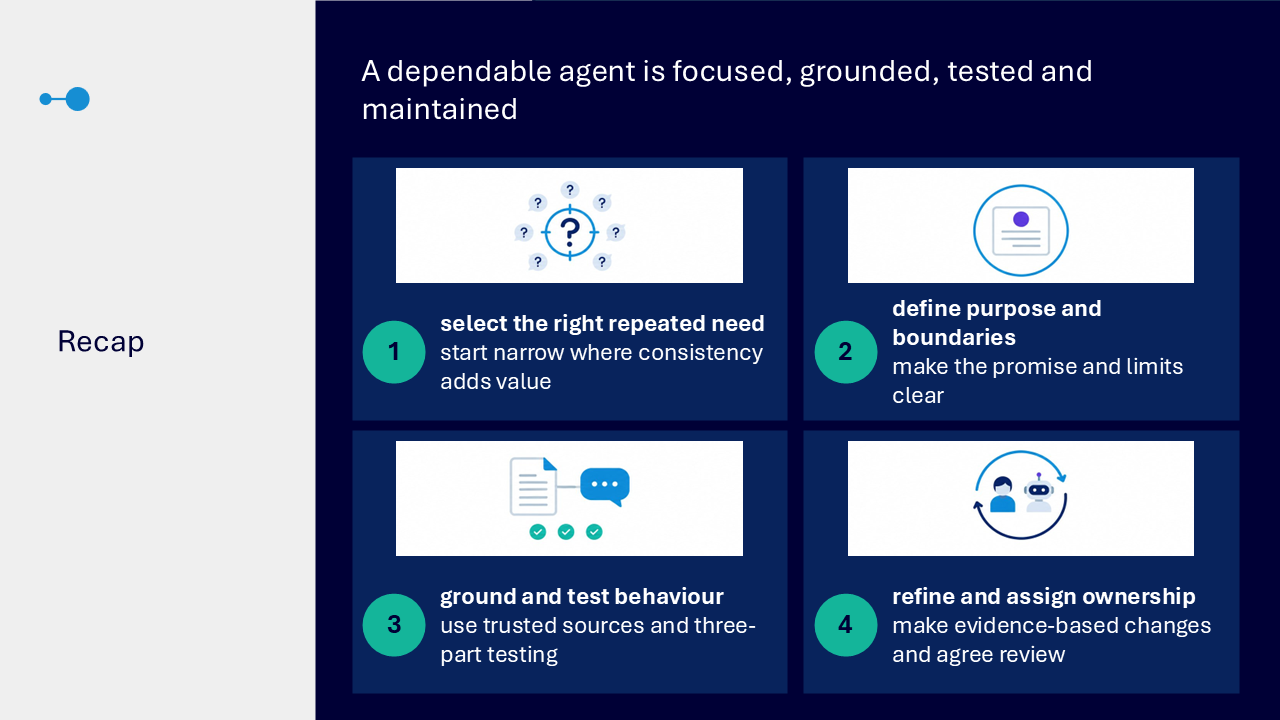
A dependable agent journey
- select the right repeated need
- define the promise and limits
- write repeatable behaviour
- ground the agent in trusted sources
- test three kinds of question
- make evidence-based refinements
- assign an owner and source reviewers
Actions you can take
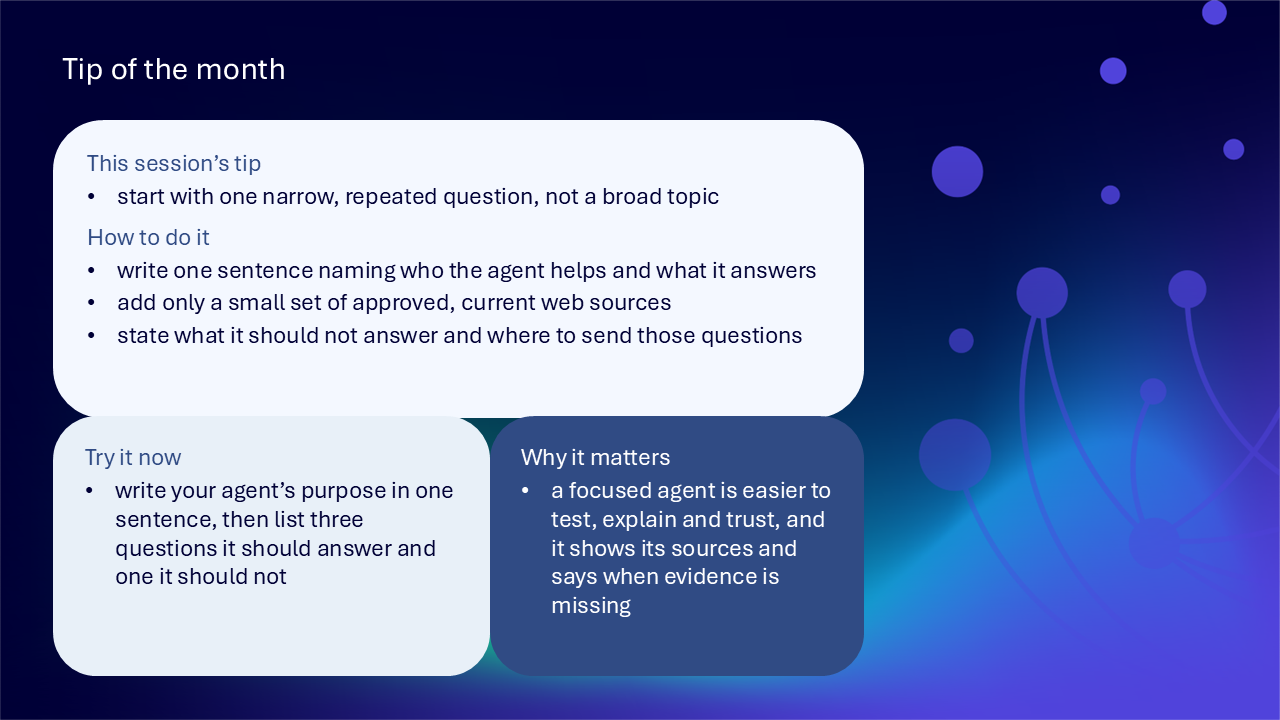
Try the tip of the month
This session’s tip: start with one narrow, repeated question, not a broad topic
How to do it: write one sentence naming who the agent helps and what it answers, add a small set of approved current web sources, and state what it should not answer and where those questions should go
Why it matters: a focused agent is easier to test, explain and trust, and can state when evidence is missing
Try it now: write the purpose in one sentence, then list three questions the agent should answer and one it should not
Build confidence with one practical route
- identify one recurring question from a stable source
- write the audience, need and output in one sentence
- list close neighbouring questions that are out of scope
- write the response pattern
- create three realistic starter prompts
- identify the owner of each source
- prepare one normal, one ambiguous and one out-of-scope test
- compare each answer with the source
- change only the instruction or source that caused a problem
- name the accountable owner and next review point
Questions and feedback
Questions are welcome. If something is unclear, ask for it to be explained another way or demonstrated again.
Complete the Support and Skilling Week feedback form
Contact WeChange.AI
For skilling queries, email training@wechange.ai.
Andrew Boxall, Managing Director: andrew@wechange.ai
Paul Ford, Industry Director for Education and Philanthropies: paul@wechange.ai
Josh Wilson, Industry Specialist: josh@wechange.ai
Elle Avilla, Customer Success and Delivery Skilling Lead: elle@wechange.ai
Izzy Pochin, Resources and Accessibility Lead: izzy@wechange.ai
Activity sheet
Follow one repeated knowledge need from suitability and purpose through instructions, trusted sources, three-part testing, refinement and proportionate ownership.
How to use this activity sheet
This sheet supports Session 18: Microsoft Copilot. Use it after the live session, or follow selected activities while your trainer demonstrates one narrow agent design from initial need through to testing and review.
- work at your own pace and pause after each activity
- use a low-risk, non-sensitive knowledge scenario
- use only approved and current sources you are permitted to access
- keep the agent focused on information rather than accountable decisions
- record gaps and limitations instead of filling them with plausible detail
What you will achieve
- decide whether a repeated need justifies an agent or only a one-off prompt
- write a narrow one-sentence purpose naming audience, need and output
- define related questions the agent should not answer or decide
- write instructions for response structure, evidence, uncertainty and escalation
- create realistic starter prompts that teach intended use
- select a small set of authoritative, maintained sources
- review source quality, active status, ownership and gaps
- test normal questions using varied wording
- test ambiguous questions for clarification rather than assumption
- test out-of-scope questions for boundaries and onward routes
- diagnose whether an issue comes from purpose, instructions, sources or the test
- make the smallest useful refinement and rerun the same test
- record accountable ownership, source review, feedback and the next review point
Your learning route
| Stage | You will practise |
|---|---|
| 1. Choose the need | repetition, stability, risk and useful outcome |
| 2. Define the promise | purpose, audience and boundaries |
| 3. Write behaviour | instructions, response pattern and starter prompts |
| 4. Add evidence | trusted web sources, ownership and quality |
| 5. Test behaviour | normal, ambiguous and out-of-scope questions |
| 6. Refine | diagnosis, smallest change and repeated testing |
| 7. Maintain | owner, source review, feedback and review point |
Before you start
- sign in to the Copilot agent-building experience provided by your organisation
- choose one repeated, low-risk knowledge question
- identify the intended users in practical terms
- prepare a small set of approved and current web sources
- identify the human route for questions needing judgement
- avoid personal, confidential or sensitive information
- allow about 45 to 60 minutes, or complete one activity at a time
Notice: Agent creation, source types, sharing and management options depend on organisational access, licences and settings. Complete only the activities available and authorised in your environment.
Activity 1: Decide whether the need suits an agent
Outcome: Select a repeated, stable knowledge need where consistency adds value without removing necessary judgement.
- Write the recurring question or knowledge task.
- Identify the audience that regularly asks it.
- Check whether the answer comes from stable, trusted information.
- Decide whether consistent support would reduce repeated drafting.
- Confirm that the agent will support understanding rather than replace an accountable decision.
- Describe what a useful answer should enable the user to understand or do.
| Suitability check | Your finding |
|---|---|
| repeated question or task | |
| intended audience | |
| stable trusted information | |
| value of consistency | |
| human judgement that must remain | |
| useful outcome |
Pause and check
Activity 2: Choose between an agent and a prompt
Outcome: Use the lightest approach that fits the frequency and stability of the task.
| Approach | Use it when | Your decision |
|---|---|---|
| one-off prompt | the task is occasional or the purpose and sources change | |
| agent | the same purpose, audience and response approach should be reused |
- Ask whether this question is likely to recur.
- Check whether instructions and sources can remain stable.
- Identify any changing need that could create false consistency.
- Choose a prompt or agent.
- Record what must be proven before the use case is expanded.
The approach I chose: ____________________________________________________________________
My reason: ____________________________________________________________________
What I will prove before expanding: ____________________________________________________________________
Pause and check
Activity 3: Write the one-sentence purpose
Outcome: Create a focused promise that anchors every later design and testing decision.
- State who the agent helps.
- State the repeated question or knowledge need.
- State the expected output, such as an answer, summary, signpost, checklist or next step.
- Combine these elements into one sentence.
- Remove any topic or audience that makes the promise difficult to explain or test.
| Purpose element | Your wording |
|---|---|
| who the agent helps | |
| repeated need | |
| expected output | |
| one-sentence purpose |
Pause and check
Activity 4: Define the audience and response assumptions
Outcome: Adapt language, context and expectations to the intended users.
- Describe what the intended users are likely to know.
- Identify any term that needs plain-language explanation.
- Record any source access that may differ between users.
- Choose an appropriate level of detail.
- Write one realistic question in the language the audience would naturally use.
| Audience decision | Your note |
|---|---|
| what users already know | |
| terms needing explanation | |
| possible permission differences | |
| tone and detail | |
| realistic user wording |
Pause and check
Activity 5: Define boundaries and onward routes
Outcome: State what the agent should not answer or decide, and where users should go next.
- List one adjacent question that is outside scope.
- List one decision the agent must not make.
- Define what the agent should say when evidence is missing or insufficient.
- Name the owner, process or source for questions requiring judgement.
- Check that the boundary is more specific than everything else.
| Boundary area | Your wording |
|---|---|
| related exclusion | |
| decision reserved for a person or process | |
| missing-evidence response | |
| onward route |
Pause and check
Activity 6: Write the agent instructions
Outcome: Turn purpose and boundaries into clear, repeatable behaviour.
- State the role and task directly.
- Define the response structure, tone and level of detail.
- Require the agent to stay grounded in approved sources.
- Require it to distinguish supported evidence from gaps.
- State how to handle ambiguous questions.
- State how to handle sensitive, unsupported or out-of-scope questions.
- Read the instructions and remove vague or conflicting wording.
| Instruction area | Your wording |
|---|---|
| role and task | |
| response structure | |
| tone and detail | |
| source use | |
| uncertainty behaviour | |
| clarification behaviour | |
| out-of-scope or escalation behaviour |
Pause and check
Activity 7: Create a dependable response pattern
Outcome: Make supported answers, limits and next steps easy for users to recognise.
- Write the opening pattern for answering the question first.
- Write how the source basis should be shown where supported.
- Write the phrase or structure for stating limits plainly.
- Write how the response should finish with the useful next step.
- Check that the pattern does not hide uncertainty behind a polished format.
| Response part | Your pattern |
|---|---|
| supported answer first | |
| source basis | |
| limit or gap | |
| useful next step |
Pause and check
Activity 8: Write starter prompts
Outcome: Teach intended use through realistic, actionable examples.
- Write a starter prompt for finding information.
- Write one for explaining information.
- Write one for comparing or applying information where this is in scope.
- Use wording the intended audience would naturally use.
- Remove any starter that stretches beyond the boundary.
- Make the likely output evident from the wording.
| Starter pathway | Your prompt |
|---|---|
| find | |
| explain | |
| compare or apply | |
| another main pathway, if needed |
Pause and check
Activity 9: Select trusted sources
Outcome: Create a small evidence set of maintained, approved and appropriately accessible material.
- List the approved web sources needed for the narrow purpose.
- Confirm that each source is authoritative for the topic.
- Check who maintains each source.
- Remove outdated or duplicate material.
- Confirm that access is governed by existing permissions.
- Record an evidence gap rather than adding a weak source.
| Source review | Your finding |
|---|---|
| source and scope | |
| authority or approval | |
| maintainer | |
| current or superseded status | |
| access boundary | |
| known gap |
Pause and check
Activity 10: Review source quality for agent use
Outcome: Identify improvements that help the agent and people locate the intended evidence.
- Check that titles and headings describe the content.
- Make an important rule explicit rather than implied.
- Separate active guidance from historic information.
- Label or remove superseded material.
- Record a missing answer for human maintenance.
- Avoid treating a source gap as permission to invent an answer.
| Source-quality check | Finding | Maintenance action |
|---|---|---|
| titles and headings | ||
| explicit rules | ||
| active and historic separation | ||
| superseded material | ||
| missing answer |
Pause and check
Activity 11: Test normal questions
Outcome: Confirm that the core journey produces accurate and useful answers from trusted information.
- Ask one representative, high-value repeated question.
- Ask the same question using different wording.
- Compare both responses with the source.
- Check whether the answer gives the audience enough context to act.
- Check the source basis and next step.
- Record any difference that changes meaning or usefulness.
| Normal test | Result |
|---|---|
| representative question | |
| varied wording | |
| source accuracy | |
| audience usefulness | |
| source and next step visible | |
| issue found |
Pause and check
Activity 12: Test ambiguous questions
Outcome: Check that the agent asks a small, specific question rather than making an unsupported assumption.
- Remove one important detail from a normal question.
- Combine two possible meanings.
- Use one internal abbreviation or shorthand.
- Check whether the agent separates possibilities or asks for context.
- Review whether the clarification question is small and specific.
- Record any unsafe assumption.
| Ambiguous test | Expected behaviour | Observed behaviour |
|---|---|---|
| missing detail | ||
| two possible meanings | ||
| internal shorthand | ||
| clarification question |
Pause and check
Activity 13: Test out-of-scope questions
Outcome: Confirm that the agent maintains the boundary, protects accountability and gives an onward route.
- Ask an adjacent question outside the purpose.
- Ask the agent to make a decision reserved for a person or process.
- Ask for information absent from the sources.
- Check that the response does not quietly expand the role.
- Check that the evidence gap is stated.
- Check that the onward route is useful.
| Out-of-scope test | Expected behaviour | Observed behaviour |
|---|---|---|
| adjacent question | ||
| accountable decision | ||
| unsupported information | ||
| onward signpost |
Pause and check
Activity 14: Diagnose and refine one thing at a time
Outcome: Correct the cause of unwanted behaviour while preserving what already works.
- Choose one failed or weak test.
- Decide whether the cause is the purpose, instruction, source or test.
- Make the smallest relevant change.
- Run the same test again.
- Compare the new response with the intended behaviour.
- Rerun at least one earlier test that already worked.
- Add the question to a short reusable test set.
| Refinement record | Your note |
|---|---|
| test question | |
| diagnosed cause | |
| smallest change | |
| result after change | |
| previous behaviour rechecked | |
| test-set entry |
Pause and check
Activity 15: Assign ownership and review
Outcome: Create a proportionate maintenance arrangement before wider sharing.
- Name the accountable owner for purpose and boundaries.
- Name who reviews source quality and currency.
- Choose a review trigger or point.
- Define a feedback route for missing, unclear or incorrect responses.
- Record who decides whether to refine, restrict or retire the agent.
- Confirm the intended sharing arrangement.
| Ownership decision | Your arrangement |
|---|---|
| accountable owner | |
| source reviewer | |
| review trigger or point | |
| feedback route | |
| refine, restrict or retire decision | |
| sharing arrangement |
Pause and check
Put it into practice: design one focused repeated-question agent
Scenario: A service team receives the same questions about an established process. Approved web guidance exists, but colleagues interpret it differently and sometimes ask for decisions the guidance cannot make.
- confirm that the need is repeated, stable and knowledge-focused
- write the one-sentence purpose and intended audience
- list three questions in scope and one related exclusion
- reserve accountable decisions for the correct person or process
- write instructions and a recognisable response pattern
- create realistic starter prompts
- select a small set of current approved web sources
- record source ownership and known gaps
- test normal, ambiguous and out-of-scope questions
- diagnose and refine one cause at a time
- name the owner, source reviewer, feedback route and next review point
The repeated need and audience: ____________________________________________________________________
The one-sentence purpose: ____________________________________________________________________
The boundary and onward route: ____________________________________________________________________
The source set: ____________________________________________________________________
The test finding and refinement: ____________________________________________________________________
The owner and review point: ____________________________________________________________________
Quick reference: build and review the agent
| If you need to… | Try… |
|---|---|
| decide whether an agent is justified | check repetition, stability, risk and value of consistency |
| anchor the design | a one-sentence purpose naming audience, need and output |
| protect accountable judgement | specific exclusions and an onward route |
| create repeatable behaviour | instructions for structure, evidence, gaps and escalation |
| teach intended use | realistic starter prompts |
| ground answers | a small set of current, approved web sources |
| check core behaviour | normal questions with varied wording |
| check assumptions | ambiguous questions missing key details |
| check the boundary | adjacent, decision and unsupported questions |
| fix a weak response | diagnose the cause and make the smallest change |
| maintain trust | owner, source reviewer, feedback route and review point |
Your three takeaways
My most useful learning: ____________________________________________________________________
What I will implement: ____________________________________________________________________
What I will explore further: ____________________________________________________________________
If you need help
- describe the repeated question and intended audience
- name whether the issue concerns purpose, instructions, starter prompts, sources or testing
- provide the exact wording of the test question and unexpected response using only safe information
- ask your local support route about agent creation, sources, sharing or unavailable features
- avoid including personal, confidential or sensitive information in prompts or screenshots
Confidence grows through a controlled agent journey: start narrow, make the promise and boundaries clear, ground behaviour in trusted sources, test deliberately and maintain accountable ownership.
Reflective journal
Why we ask you to reflect
Continuing Professional Development (CPD) is formative and it is about what it achieves for you and your organisation.
Instead of formally assessing your learning, we ask you to write a reflective note. This should reflect on how the learning was relevant and how it will impact your working practices.
Taking time to reflect on your learning makes it more likely you will embed it in your future practice.
What to cover and when
What your reflection should cover
- how the learning was relevant to you
- how the learning will impact your practice
When to complete it
Reflect as soon as possible following the skilling session. This keeps your note contemporaneous (written close to the time) and meaningful. Fill it in on your device, so the boxes expand as you type.
| Topic | What to know |
|---|---|
| Timing | Complete the note as soon as possible after the training event. |
| Purpose | To embed the learning within your subsequent practice. |
| Focus | How the learning was relevant and how it will impact your practice. |
Your reflective note
Complete each row below. Write in your own words. Your notes are private to you unless you choose to share them.
| Prompt | Your response |
|---|---|
| Skilling session title | |
| Date of the skilling session | |
| Date you completed this note | |
| How was the learning relevant to you and your work? | |
| How will the learning impact your practice? |
Recommended resources
These curated resources accompany the WeChange.AI skilling offer of Continuing Professional Development (CPD) accredited, and non-accredited, sessions. Use them before a session to build familiarity, or afterwards to revisit and apply the learning in day-to-day work.
Alongside these resources, Navigator helps WeChange.AI customers find personalised recommendations and available learning on Microsoft 365 tools, accessibility and AI relevant to their role. Returning to Navigator after a session can help you connect new knowledge with practical workplace needs, choose a useful next step and keep learning visible as confidence grows.
An introduction to agents and where to find them. A good place to begin before you build your own.
Explains agents as AI services that follow instructions you provide, and how to create one without coding. A practical companion to the session activity.
Describes three routes to creating an agent: describing it in natural language, configuring it manually or starting from a template. It also covers adding knowledge sources and testing your agent.
Explains what Agent Builder is for and that you can test an agent before you use, share or publish it. Available capabilities depend on your organisation’s licences, so check with your administrator.
Explains how to write good prompts for your Copilot services. Helpful when you write instructions and starter prompts for an agent.