




Accessible summary
What this session covers
This intermediate session explains how Microsoft Lists can support a shared team process. It starts with the request, case or decision the team needs to manage, then covers list structure, column choices, consistent data, views, ownership, notifications and responsible use of list data.
- defining the team process before building the list
- understanding items, columns and views
- choosing column types that match the information
- using clear names, descriptions and controlled choices
- reviewing built-in templates before adopting their structure
- adding and maintaining items through forms or grid view
- creating views for different questions and audiences
- using formatting without relying on colour alone
- making ownership and process stages visible
- using rules, reminders and Microsoft Teams connections proportionately
Making the session work for you
The session is delivered through a Microsoft Teams webinar using PowerPoint Live. You can personalise how you follow and take part. The session is recorded, and you can watch rather than follow along unless the trainer asks you to try something.
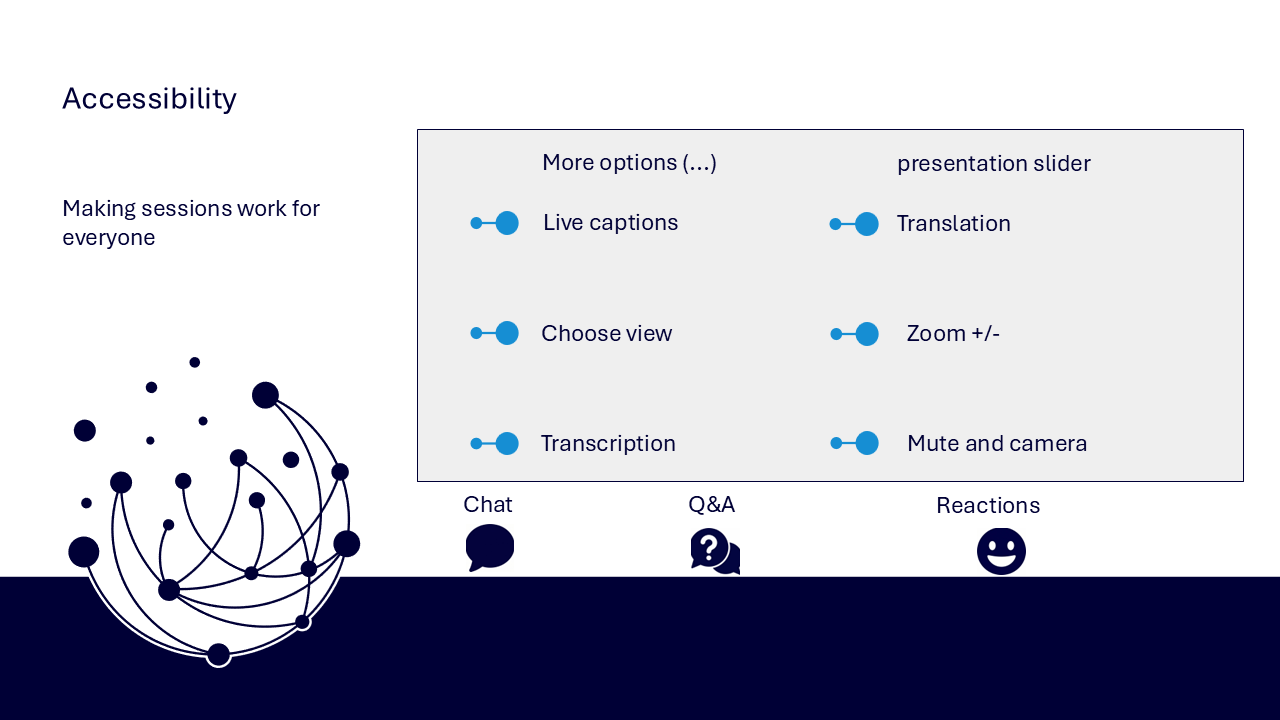
- use live captions or translation from the three-dots menu
- choose a view that gives you the clearest layout
- use the presentation slider to zoom in or out
- keep your camera and microphone off unless you are invited to use them
- use Q&A for questions and keep chat closed when you are not typing
- use reactions or another participation route if that works better for you
- share respectful feedback and use the key links provided in chat
Everyone can build confidence
These sessions are for everyone, whatever your starting point. The aim is to build the smallest useful structure for a real team process rather than add features without a clear purpose.
Navigator and WeChange.AI
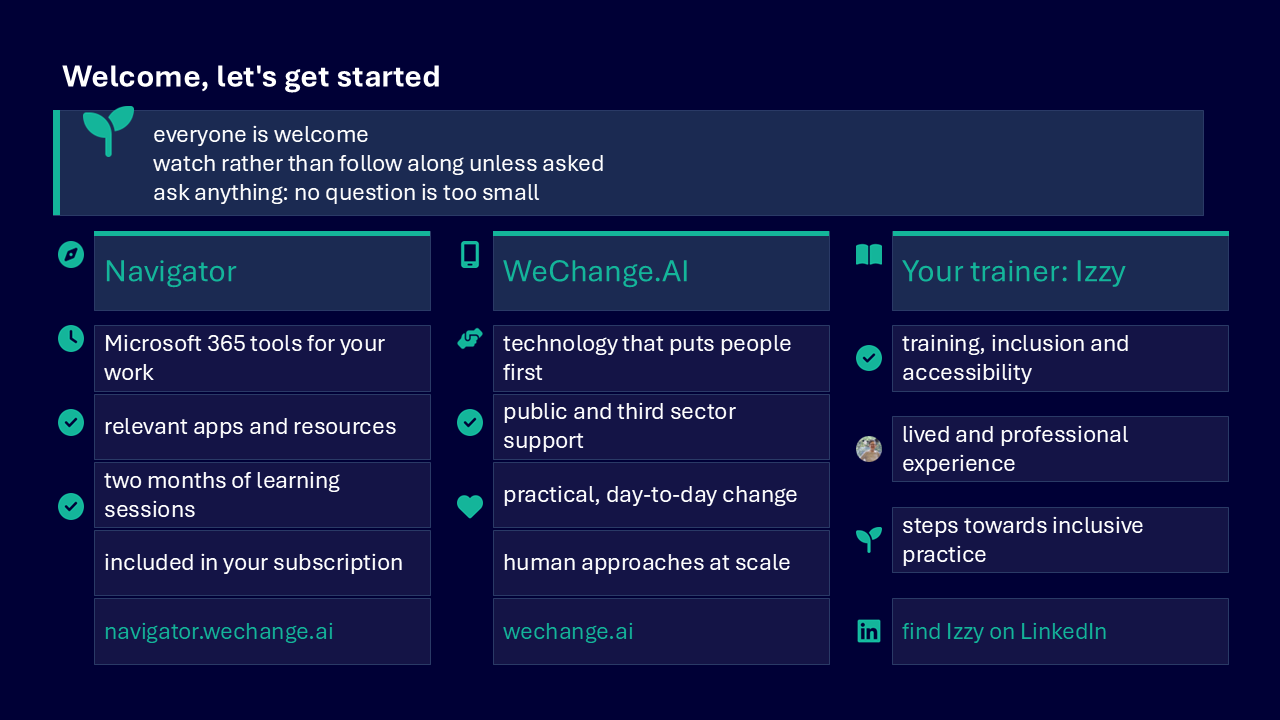
Navigator is a personalised platform for WeChange.AI customers. It helps you find Microsoft 365 tools, resources and upcoming sessions relevant to your role.
WeChange.AI supports public and third sector organisations to use technology with confidence, purpose and impact. The focus is practical, people-centred change in day-to-day work.
Key concepts
The challenge
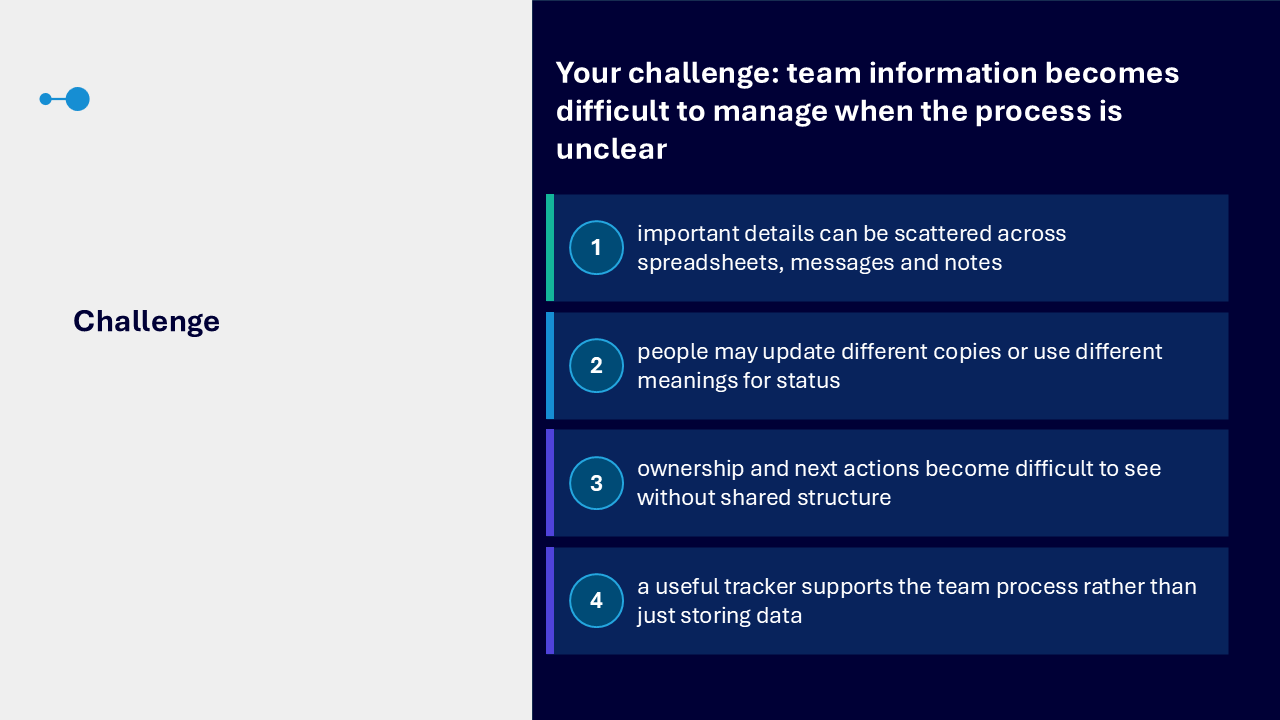
The challenge visual shows what happens when a process is unclear. Important details become scattered across spreadsheets, messages and notes. People may update different copies or use different meanings for status. Ownership and next actions become difficult to see. A useful tracker supports the team process rather than only storing data.
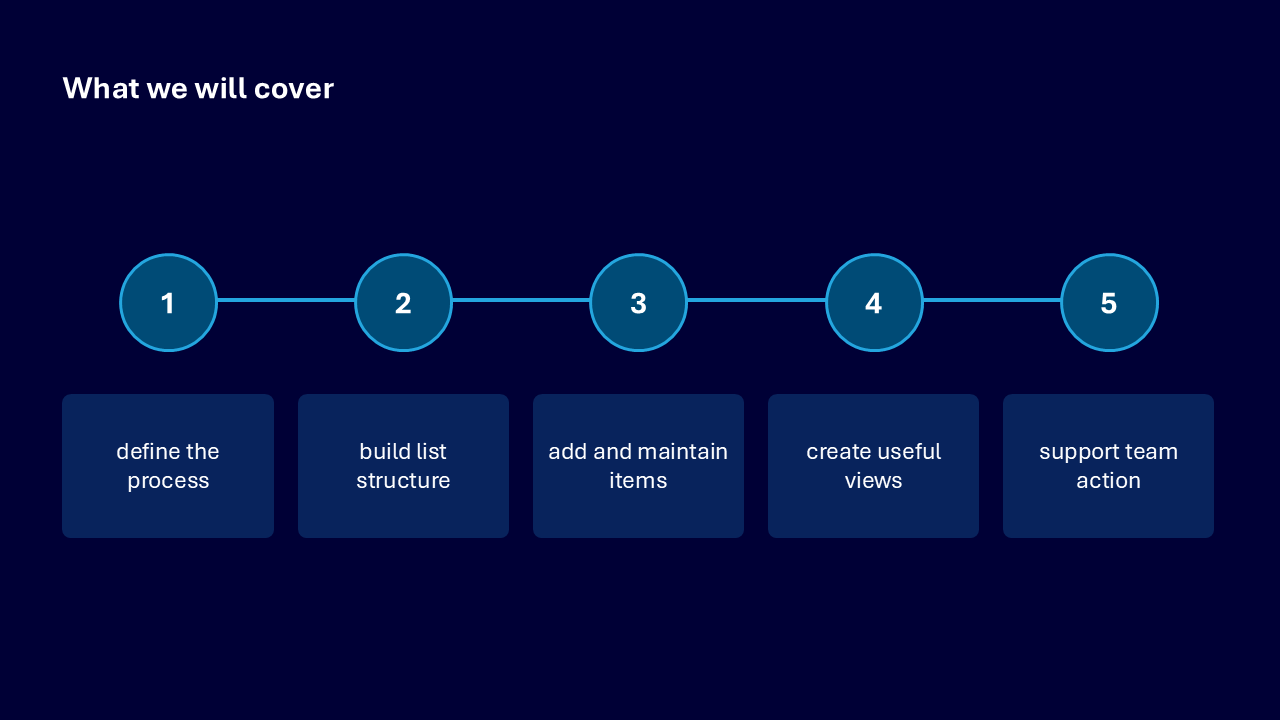
Your route through the session
- define the process
- build list structure
- add and maintain items
- create useful views
- support team action
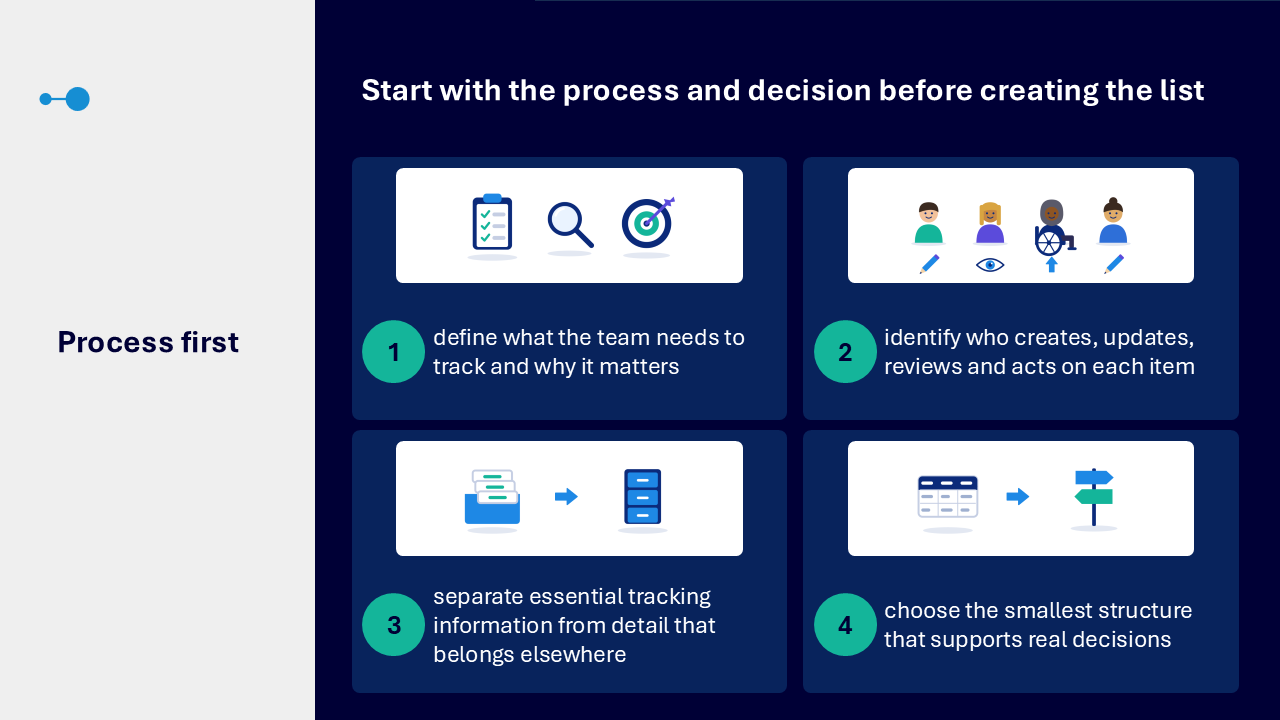
Start with the process and decision
- define what the team needs to track and why it matters
- identify who creates, updates, reviews and acts on each item
- separate essential tracking information from detail that belongs elsewhere
- choose the smallest structure that supports real decisions
Understand the Lists model
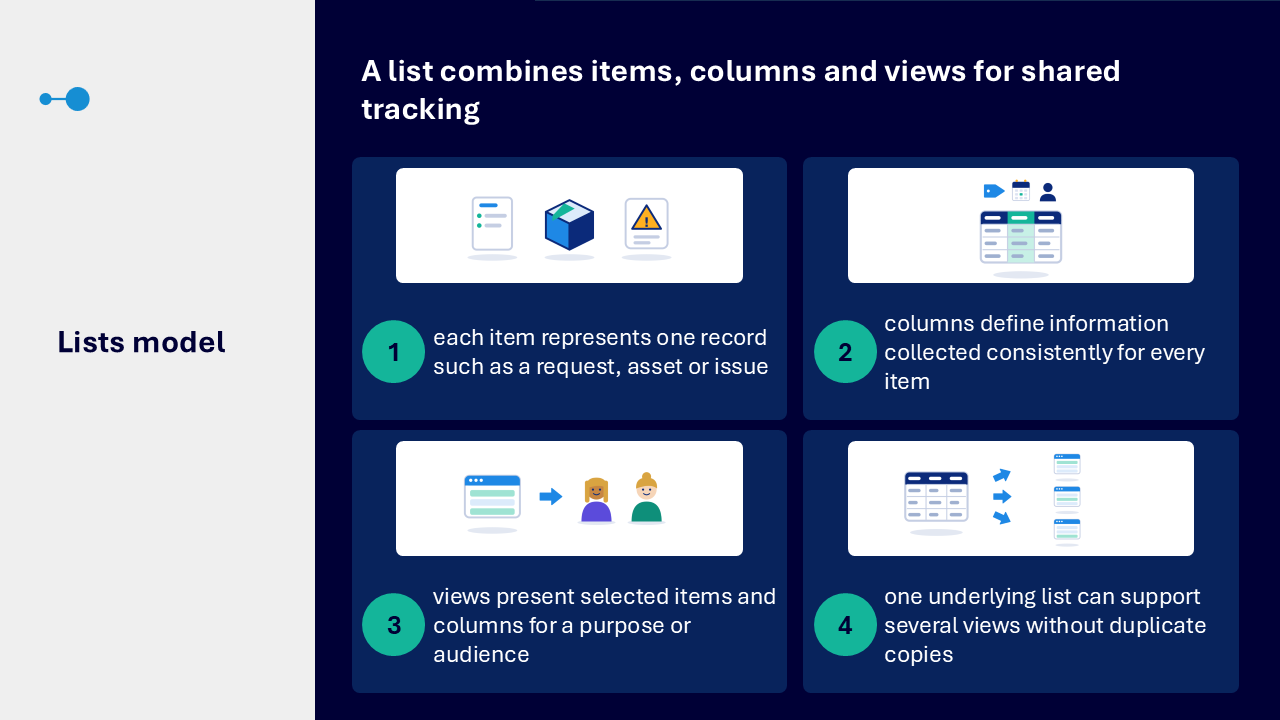
- each item represents one record such as a request, asset or issue
- columns define information collected consistently for every item
- views present selected items and columns for a purpose or audience
- one underlying list can support several views without duplicate copies
Choose suitable column types
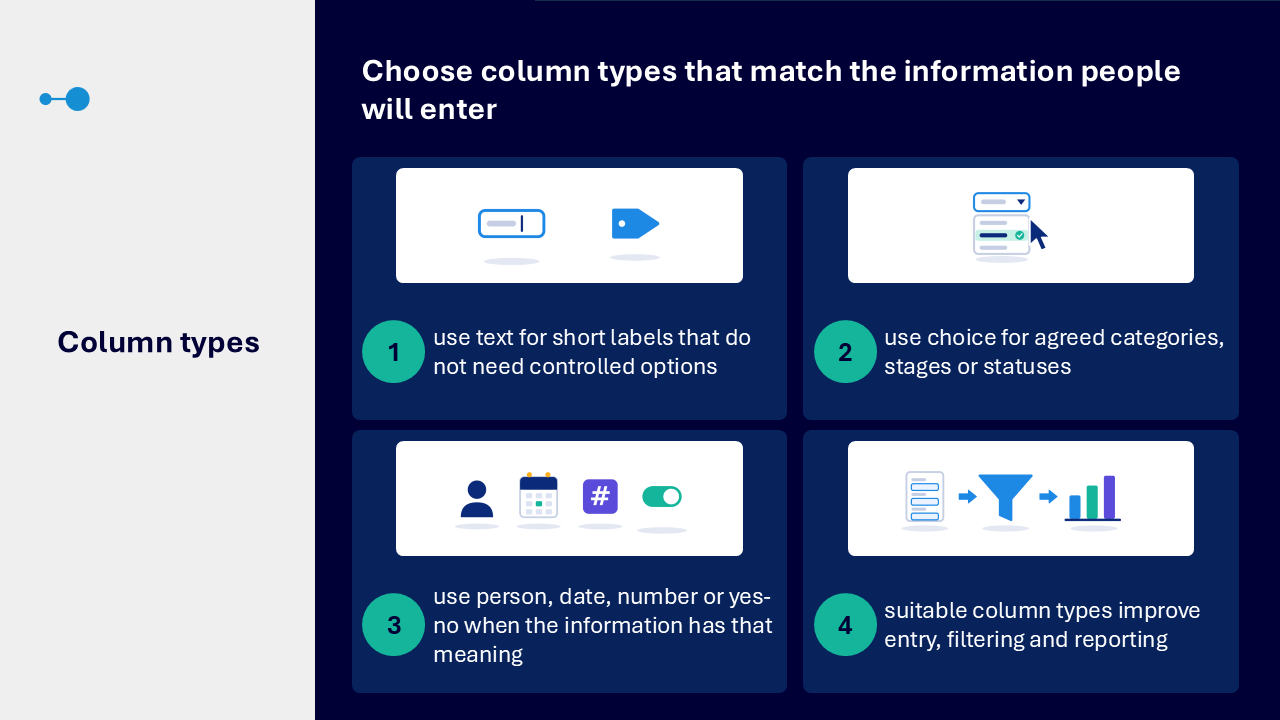
- use text for short labels that do not need controlled options
- use choice for agreed categories, stages or statuses
- use person when ownership must be visible
- use date, number or yes-no when the information has that meaning
- choose types that support accurate entry, filtering and reporting
Use clear names and descriptions
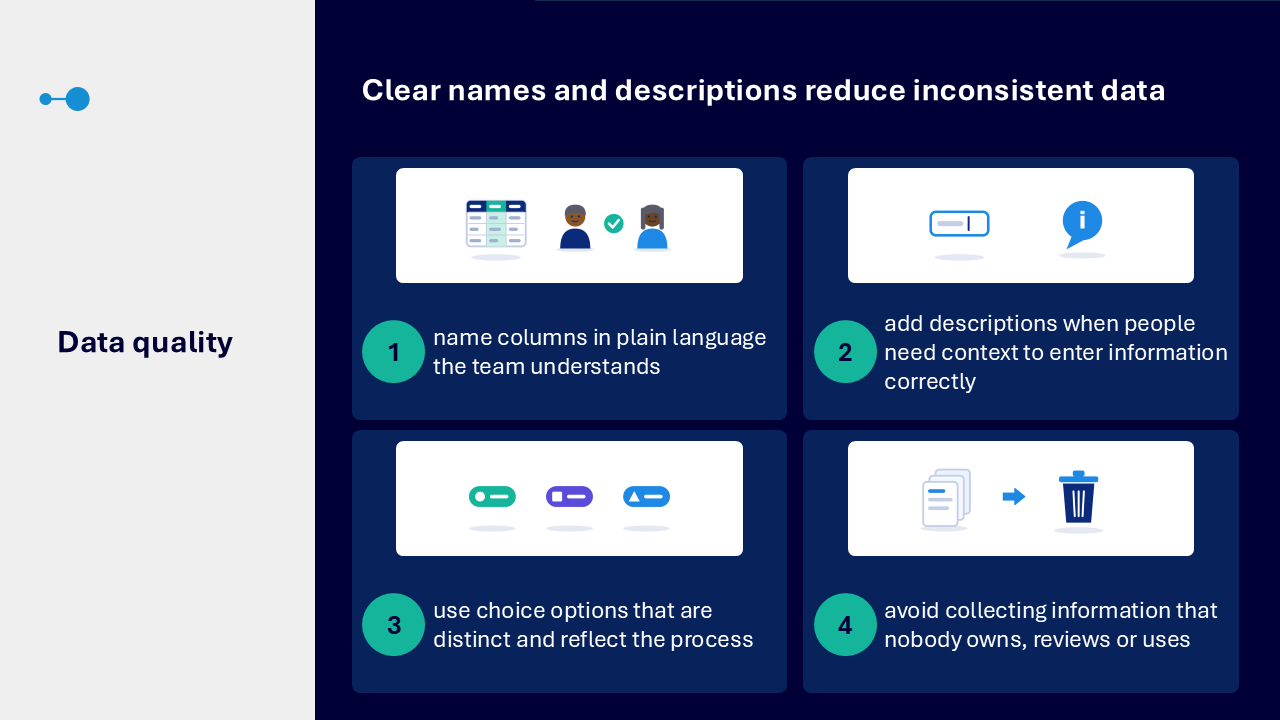
- name columns in plain language the team understands
- add descriptions when people need context to enter information correctly
- make choice options distinct and aligned with the process
- avoid collecting information that nobody owns, reviews or uses
Review templates before use
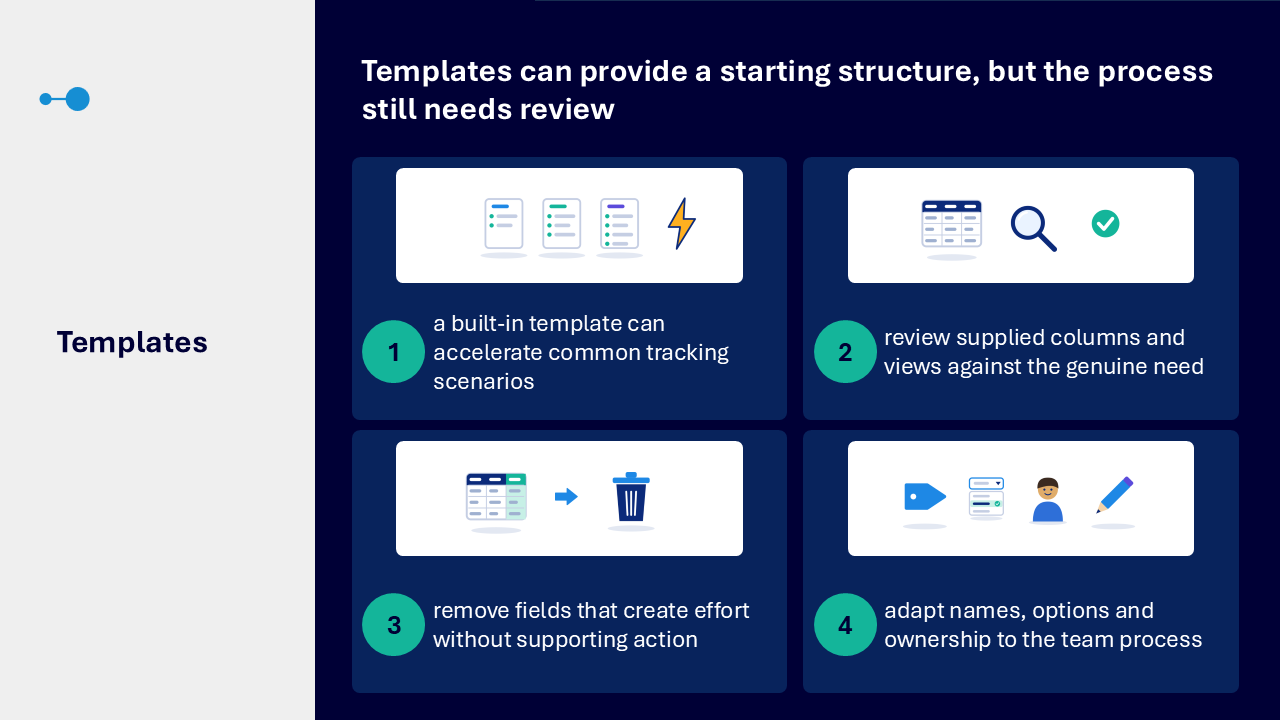
- use a built-in template as a possible starting structure
- compare supplied columns and views with the genuine need
- remove fields that create effort without supporting action
- adapt names, options and ownership to the team process
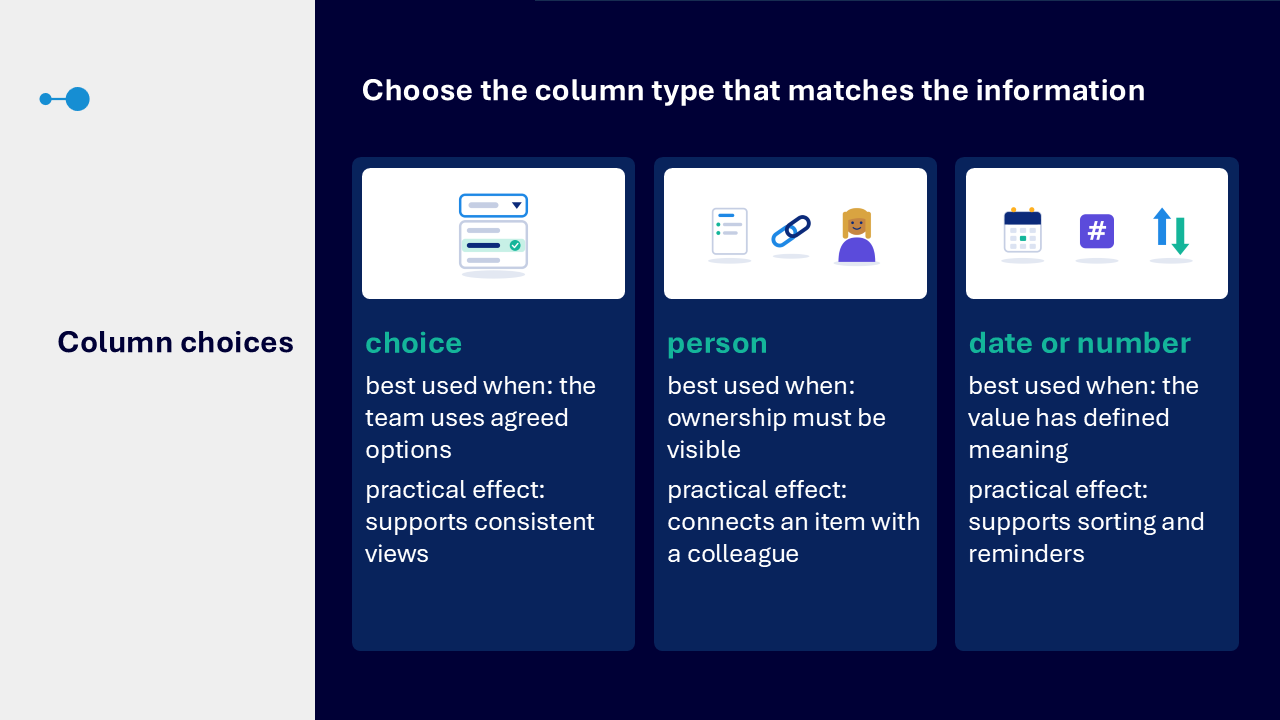
Choose the column type by purpose
The comparison connects three column types to their practical effect.
- choice: agreed options that support consistent views
- person: visible ownership connected to a colleague
- date or number: defined values that support sorting and reminders
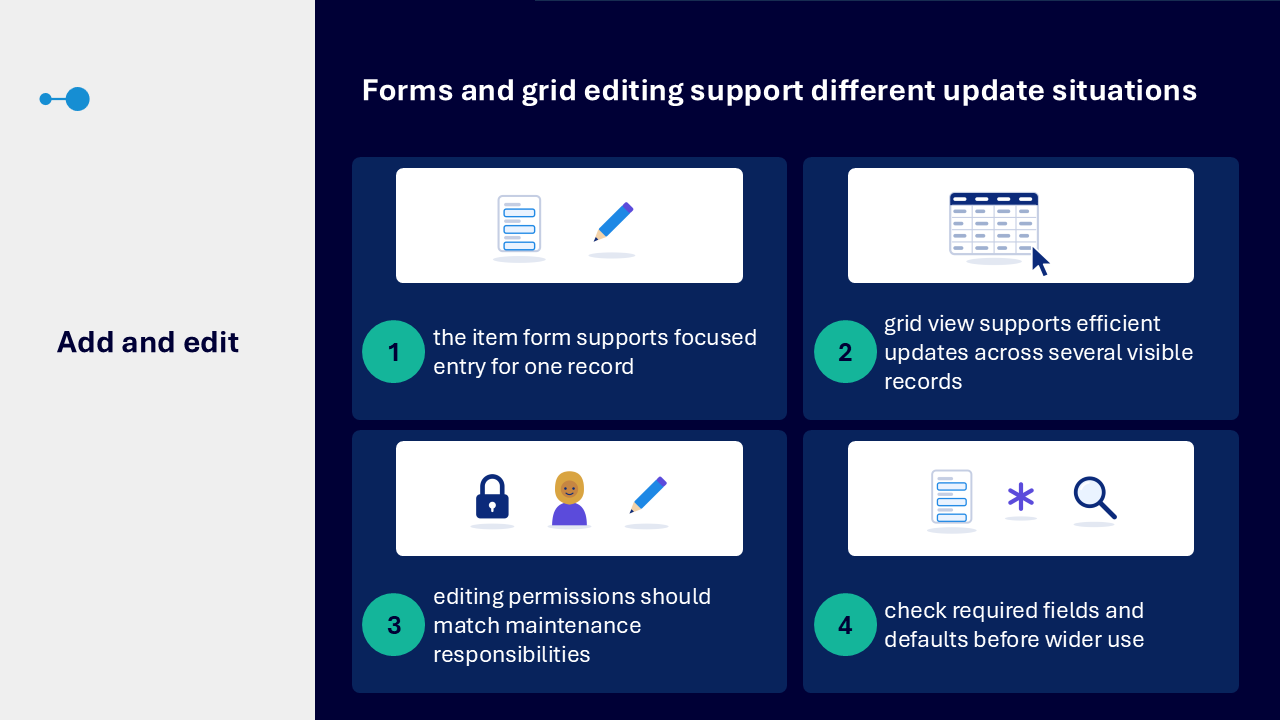
Add and edit items
- use the item form for focused entry of one record
- use grid view for efficient updates across several visible records
- match editing permissions to maintenance responsibilities
- check required fields and defaults before wider use
Create useful views
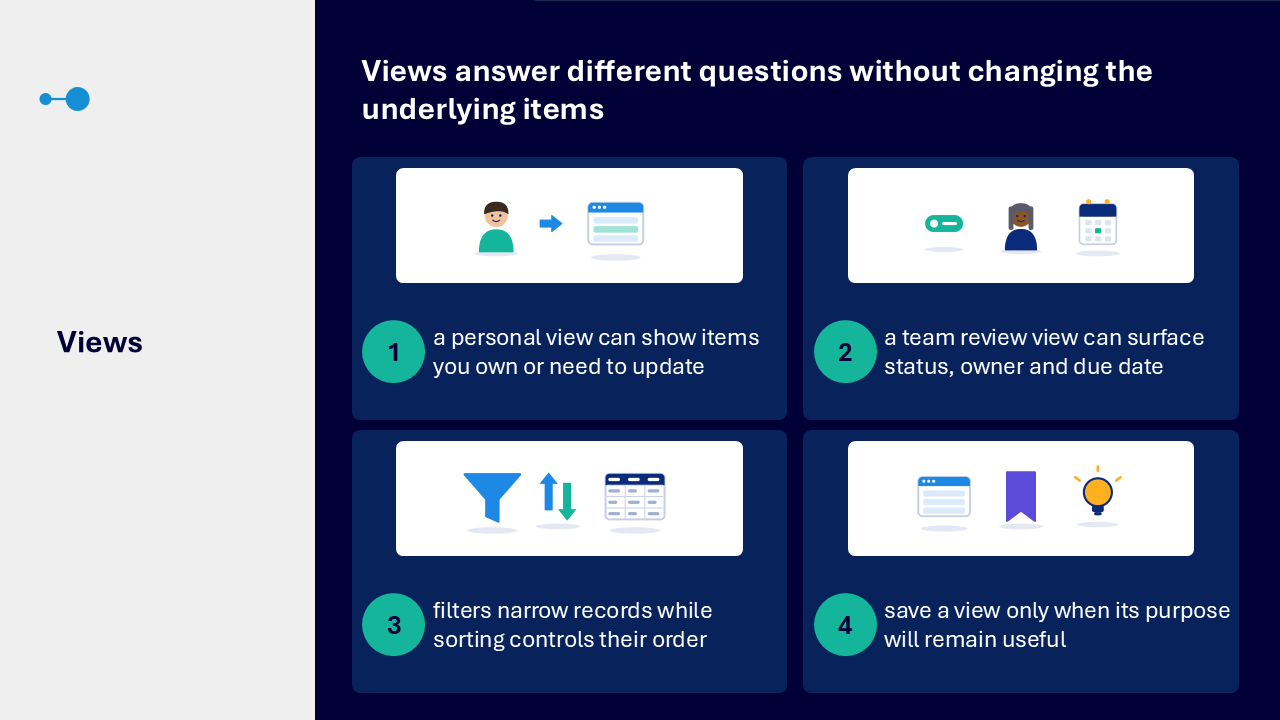
Views answer different questions without changing the underlying items.
- use a personal view for items you own or need to update
- use a team review view to show status, owner and due date
- use filters to narrow records
- use sorting or grouping to make sequence and categories visible
- save a view only when its purpose will remain useful
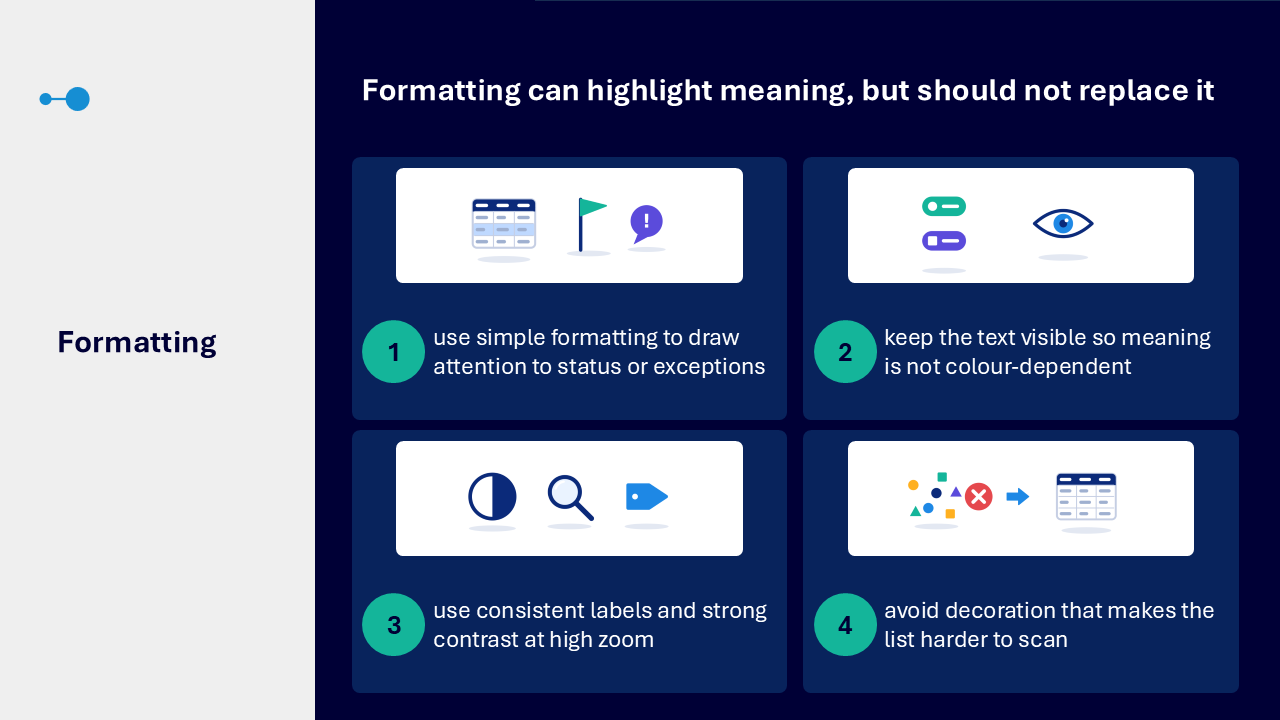
Use formatting to highlight meaning
- use simple formatting to draw attention to a status or exception
- keep the text visible so meaning does not depend on colour
- use consistent labels and strong contrast at high zoom
- avoid decoration that makes the list harder to scan
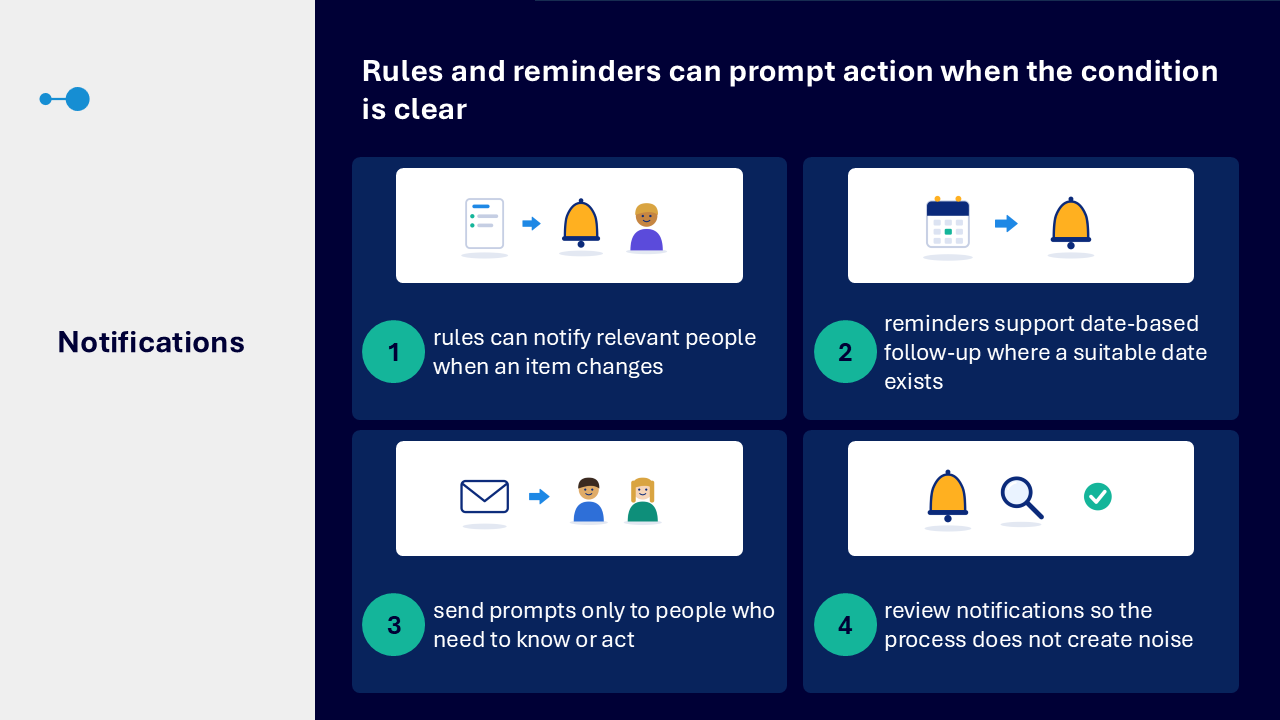
Use rules and reminders proportionately
- use rules to notify relevant people when an item changes
- use reminders for date-based follow-up where a suitable date exists
- send prompts only to people who need to know or act
- review notifications so the process does not create noise
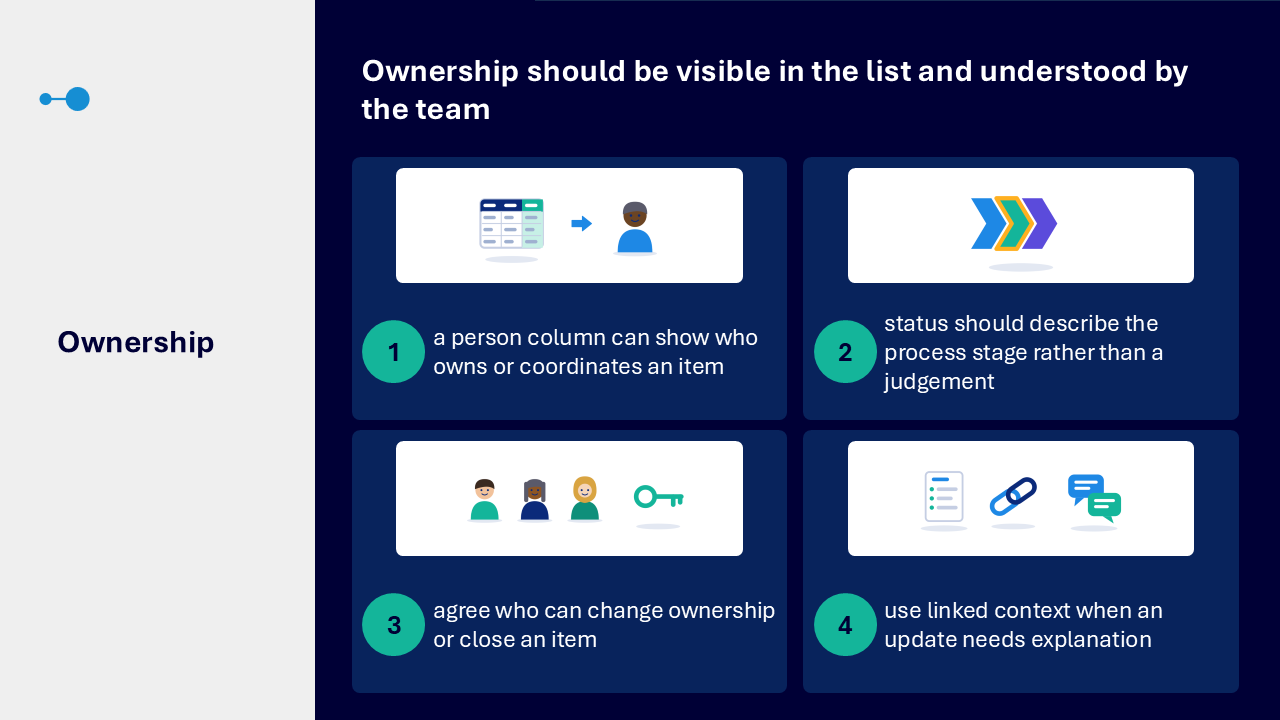
Make ownership visible
- use a person column to show who owns or coordinates an item
- use status to describe the process stage rather than a judgement
- agree who can change ownership or close an item
- link to supporting context when an update needs explanation
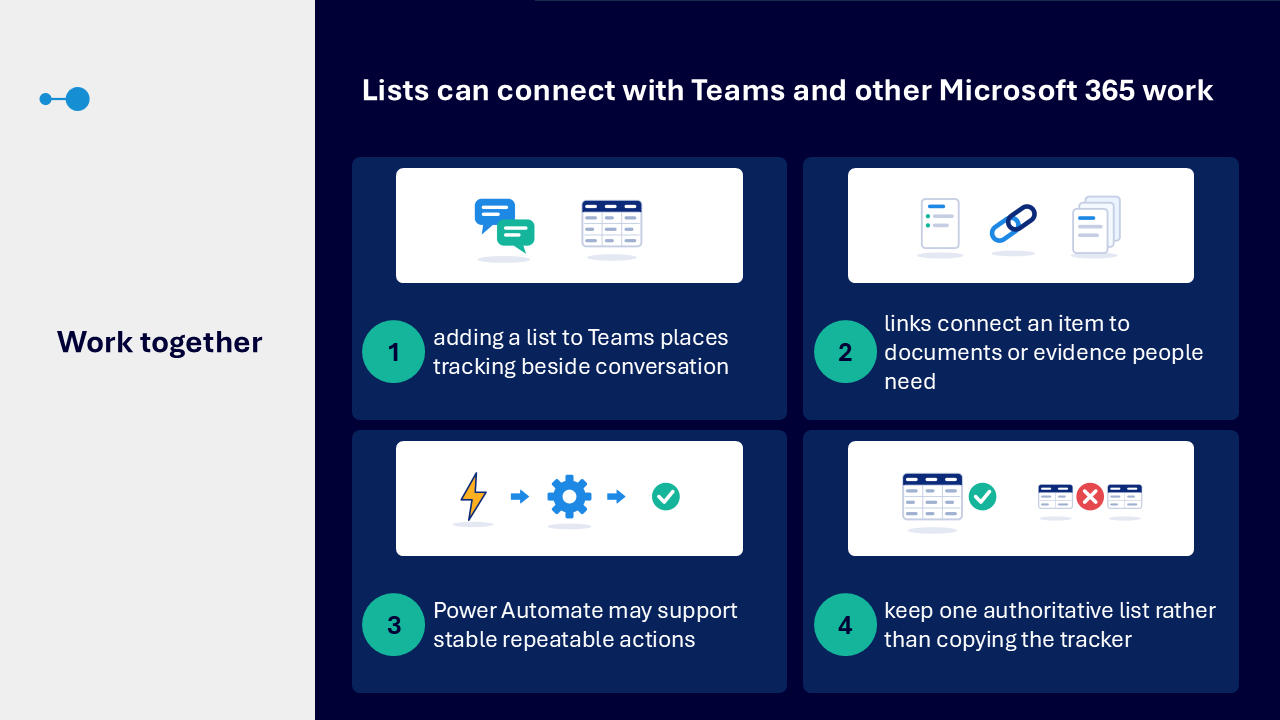
Connect Lists with team work
- add a list to Microsoft Teams when tracking should sit beside conversation
- use links to connect an item with documents or evidence
- consider Power Automate for stable, repeatable actions
- keep one authoritative list rather than copying the tracker
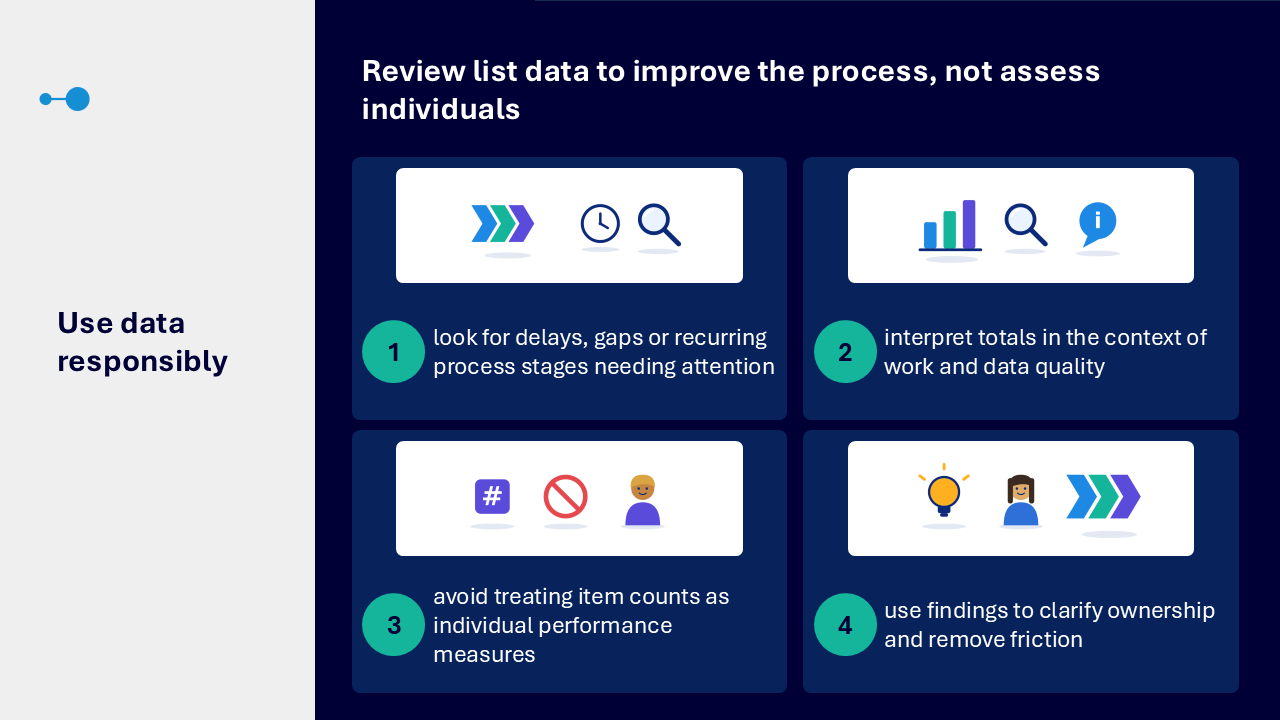
Use list data responsibly
Review list data to improve the process, not to assess individuals.
- look for delays, gaps or recurring stages that need attention
- interpret totals in the context of the work and data quality
- avoid treating item counts as individual performance measures
- use findings to clarify ownership and remove friction
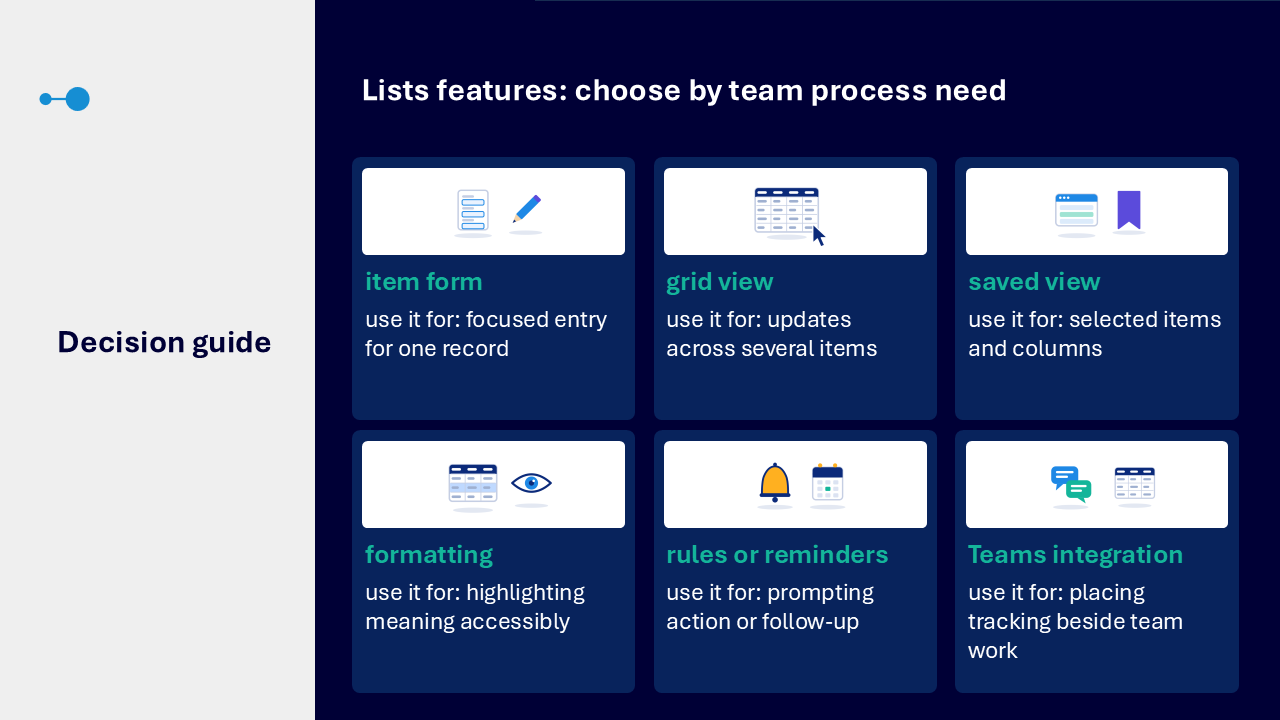
Choose Lists features by process need
- item form: focused entry for one record
- grid view: updates across several items
- saved view: selected items and columns
- formatting: highlighting meaning accessibly
- rules or reminders: prompting action or follow-up
- Teams integration: placing tracking beside team work
What the visuals and demonstrations showed
The visual sequence followed a tracker from process definition through list design and team action.
- defining the request or case process and its ownership
- creating one item for each record
- choosing columns for agreed categories, owners and dates
- using clear names, descriptions and distinct options
- checking a template against the genuine need
- adding an item through a form
- updating several records through grid view
- creating a saved view for a recurring question
- filtering, sorting or grouping without duplicating data
- using accessible formatting to show status
- using a rule or reminder for a clear condition
- placing the authoritative list beside team conversation
- using data to identify process friction rather than judge individuals
Key takeaways
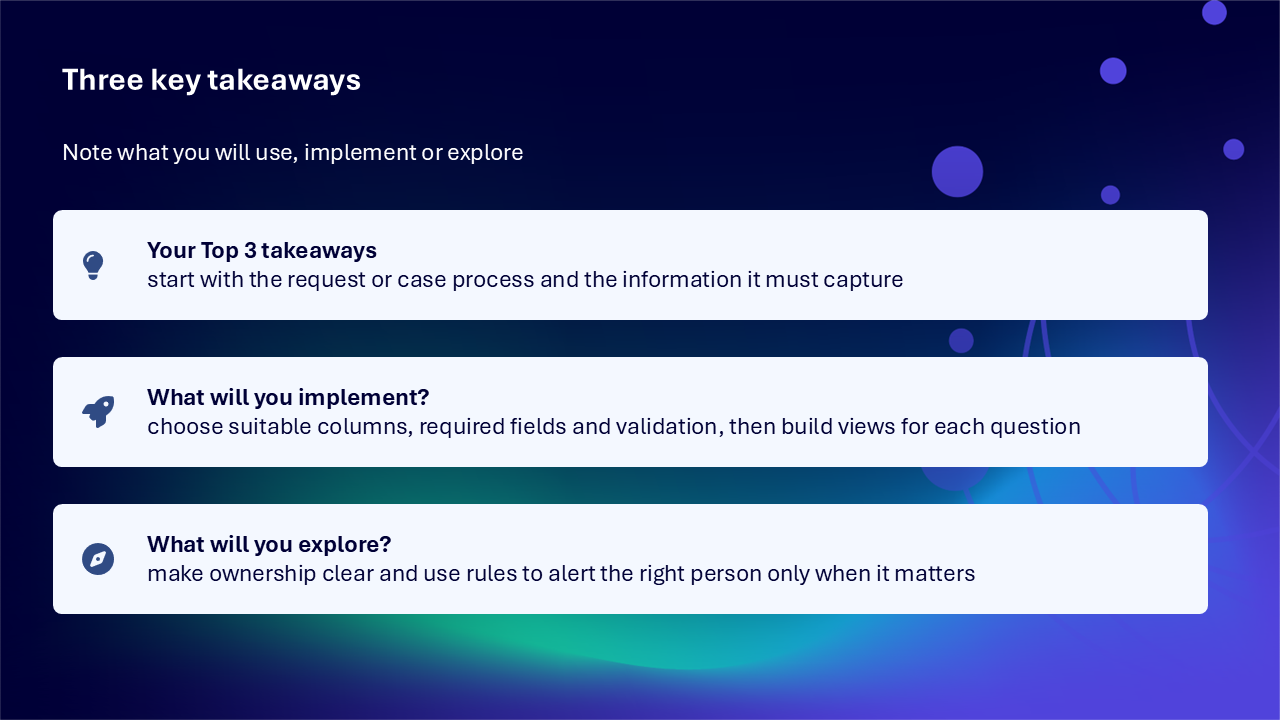
- start with the request or case process and the information it must capture
- choose suitable columns, required fields and validation
- use controlled choices for agreed stages or statuses
- build views for recurring questions and audiences
- make ownership visible
- use formatting without relying on colour alone
- use rules and reminders only when the condition and recipient are clear
- keep one authoritative list
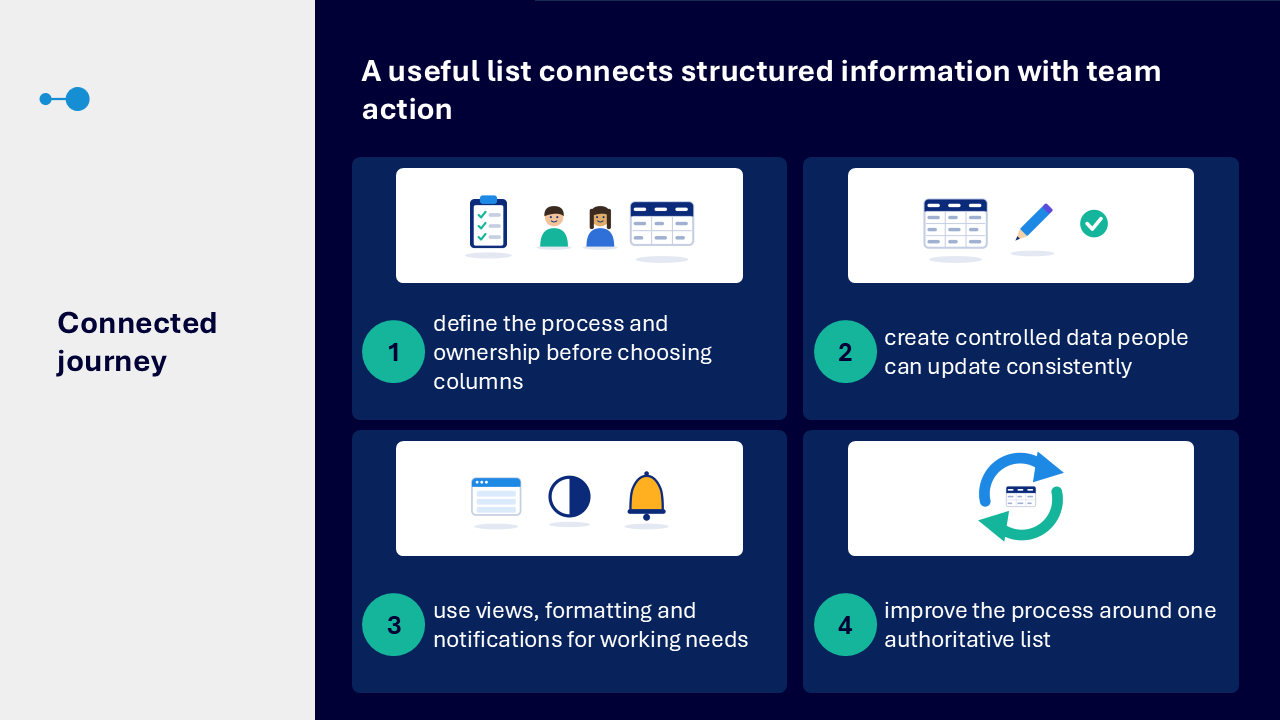
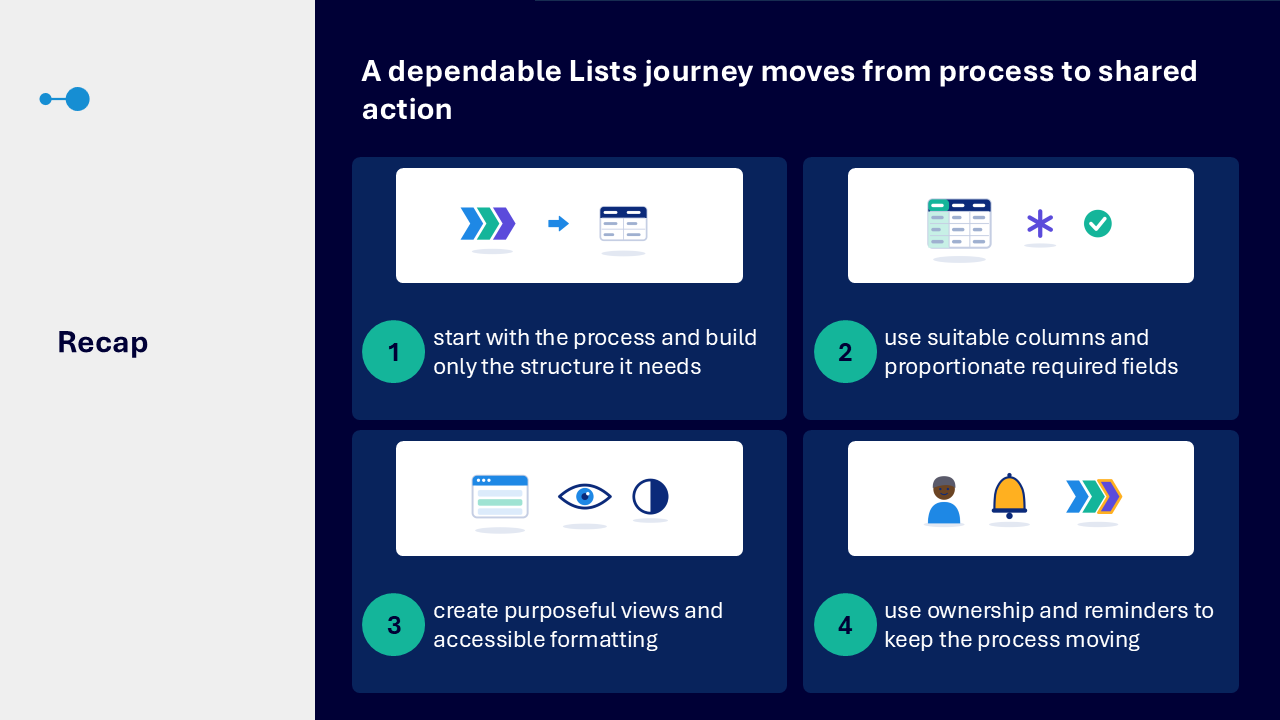
A dependable Lists journey
- define the process and ownership
- create the smallest useful list structure
- collect controlled information consistently
- maintain items through suitable editing routes
- create views for real working questions
- use accessible formatting and proportionate notifications
- improve the process around one authoritative list
Actions you can take
Try the tip of the month
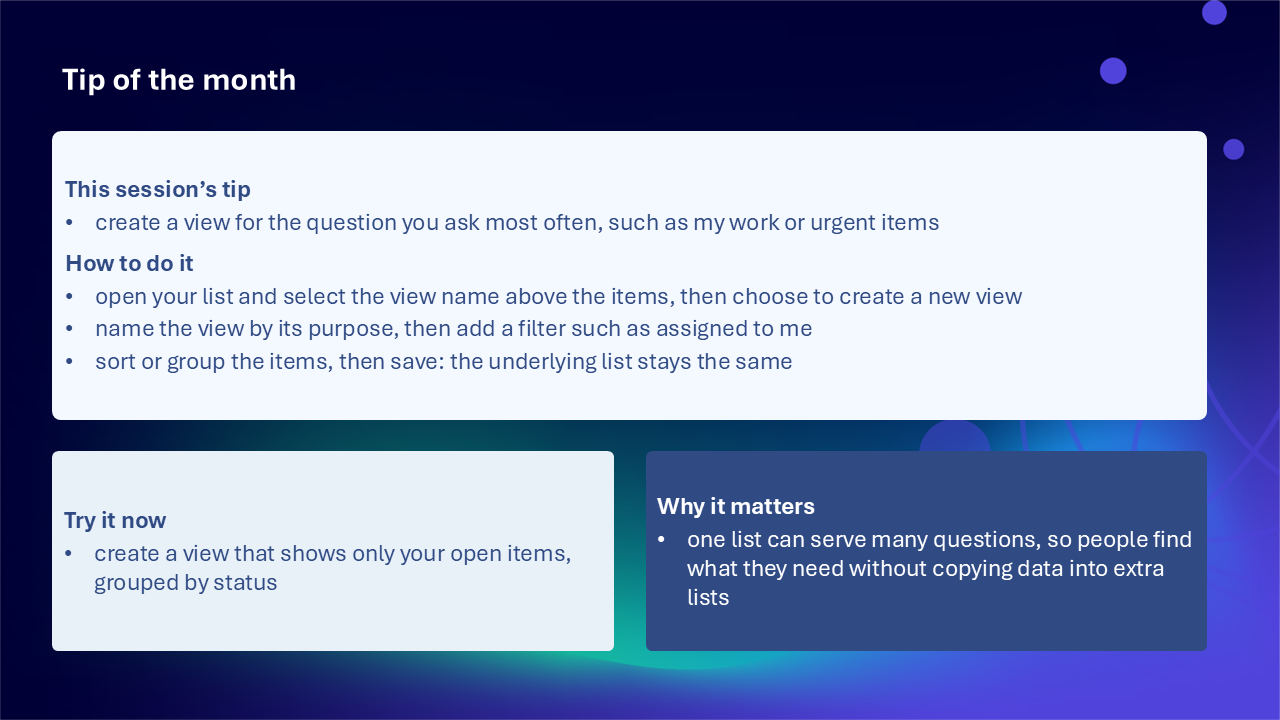
This session’s tip: create a view for the question you ask most often, such as my work or urgent items
How to do it: open the list, create a new view, name it by purpose, add a filter such as assigned to me, then sort or group the items and save
Why it matters: one list can answer several questions without copying data into extra lists
Try it now: create a view that shows only your open items, grouped by status
Build confidence with one practical route
- choose one team request, case or issue process
- state why the team tracks it and who acts
- list only the essential information needed for every item
- choose a suitable type for each column
- use plain-language column names and descriptions
- add one test item through the form
- update several visible items through grid view
- create one view for a recurring question
- check that status meaning remains visible without colour
- confirm who can change ownership or close an item
- review whether one useful rule or reminder is justified
Questions and feedback
Questions are welcome. If something is unclear, ask for it to be explained another way or demonstrated again. Feedback helps WeChange.AI understand what matters to you.
Complete the Support and Skilling Week feedback form
Contact WeChange.AI
For skilling queries, email training@wechange.ai.
Andrew Boxall, Managing Director: andrew@wechange.ai
Paul Ford, Industry Director for Education and Philanthropies: paul@wechange.ai
Josh Wilson, Industry Specialist: josh@wechange.ai
Elle Avilla, Customer Success and Delivery Skilling Lead: elle@wechange.ai
Izzy Pochin, Resources and Accessibility Lead: izzy@wechange.ai
Activity sheet
Follow one request or case from process definition through list structure, item updates, useful views, ownership and proportionate team action.
How to use this activity sheet
This sheet supports Session 16: Microsoft Lists. Use it after the live session, or follow selected steps while your trainer demonstrates one prepared process and one authoritative list.
- work at your own pace and pause after each activity
- use a prepared practice list or non-sensitive fictional process
- complete only actions permitted by your list role
- keep one authoritative list rather than copying the tracker
- use list data to improve the process, not assess individuals
What you will achieve
- define the process and decisions before creating a list
- distinguish items, columns and views
- choose column types that match the information
- use plain-language names, descriptions and controlled options
- review a template against the genuine process need
- add one item through a form and update several records in grid view
- create personal and team views without duplicating data
- use accessible formatting that retains visible meaning
- plan a focused rule or date-based reminder
- make ownership, status and next action visible
- connect a list with Teams, links or a stable repeatable automation where appropriate
- review process patterns in context rather than treating counts as performance measures
Your learning route
| Stage | You will practise |
|---|---|
| 1. Define the process | purpose, decisions, roles and essential information |
| 2. Build the structure | items, columns, types and validation |
| 3. Add and maintain items | forms, grid view, required fields and defaults |
| 4. Create useful views | filters, sorting, grouping and audience needs |
| 5. Support team action | formatting, ownership, rules and reminders |
| 6. Connect the work | Teams, links and repeatable automation |
| 7. Improve the process | patterns, gaps and proportionate next action |
Before you start
- open the prepared Microsoft List or create a safe practice list
- choose one fictional request, asset, issue or case process
- identify who creates, updates, reviews and acts on an item
- avoid personal, confidential or sensitive information
- make only changes you are authorised to make
- allow about 45 to 60 minutes, or complete one activity at a time
Notice: Column types, rules, reminders, Teams integration, Power Automate and permissions vary by organisational settings and your assigned access. Record what you can see if an option is unavailable.
Activity 1: Define the process before the list
Outcome: Identify what the team must track and which decisions the information supports.
- Name the request, case, asset or issue process.
- Write why tracking it matters.
- Identify who creates each item.
- Identify who updates, reviews and acts.
- Separate essential tracking information from detail that belongs in a linked document or conversation.
- Choose the smallest structure that supports genuine decisions.
| Process question | Your answer |
|---|---|
| What does each item represent? | |
| Why does the team track it? | |
| Who creates it? | |
| Who updates or reviews it? | |
| Who acts on it? | |
| What decision must the list support? |
Pause and check
Activity 2: Model items, columns and views
Outcome: Recognise how one list supports several questions without duplicate copies.
| List element | Purpose | Your example |
|---|---|---|
| item | one record, such as a request, asset or issue | |
| column | information collected consistently for every item | |
| view | selected items and columns for a purpose or audience |
- Choose one practice item.
- List the information needed for that item.
- Identify one question a personal view should answer.
- Identify one question a team review view should answer.
- Check that both views can use the same underlying items.
Pause and check
Activity 3: Choose suitable column types
Outcome: Match each field to the meaning of the information people enter.
| Column type | Best used when | Practice field |
|---|---|---|
| single line of text | a short label does not need controlled options | |
| choice | the team uses agreed categories, stages or statuses | |
| person | ownership or coordination must be visible | |
| date | timing, due dates or review dates matter | |
| number | the value has a defined numerical meaning | |
| yes or no | a clear binary condition is genuinely needed |
- Review each planned field.
- Choose the column type that represents its meaning.
- Replace free text with Choice where agreed options are needed.
- Use Person for visible ownership.
- Use Date or Number only when those values support sorting, reminders or decisions.
Pause and check
Activity 4: Improve names, descriptions and options
Outcome: Reduce inconsistent data by making each field understandable to the team.
- Rename one unclear column in plain language.
- Add a description where people need entry context.
- Review each Choice option.
- Remove overlapping or judgemental status wording.
- Check that every field has an owner, reviewer or practical use.
- Remove or question a field that nobody uses.
| Field check | Before | After |
|---|---|---|
| column name | ||
| description | ||
| choice options | ||
| status meaning | ||
| unused field |
Pause and check
Activity 5: Review a template before adopting it
Outcome: Use a template as a starting structure without allowing it to define the process.
- Open a built-in template or inspect the prepared list structure.
- Review supplied columns against the genuine process.
- Review supplied views against the team’s questions.
- Remove a field that creates effort without supporting action.
- Adapt names, options and ownership.
- Check that required fields and defaults remain proportionate.
The template or starting structure: ____________________________________________________________________
The field or view I changed: ____________________________________________________________________
Why the change fits the process: ____________________________________________________________________
Pause and check
Activity 6: Add one item with the item form
Outcome: Create a complete record using focused entry for one item.
- Open the new-item form.
- Enter a clear title or record name.
- Complete required fields.
- Choose an agreed status or category.
- Assign an owner or coordinator where appropriate.
- Add a due or review date only when it supports follow-up.
- Save the item and recognise it in the list.
| Item field | Your entry |
|---|---|
| title or record name | |
| category | |
| status | |
| owner or coordinator | |
| date, if needed | |
| linked context, if needed |
Pause and check
Activity 7: Update several records in grid view
Outcome: Make efficient, controlled updates across visible items.
- Open grid view.
- Choose only safe practice records.
- Update one repeated field across several items.
- Review required fields and data types while editing.
- Exit grid view.
- Open one changed item and check the saved values.
- Undo or correct any unintended change.
The field updated: ____________________________________________________________________
The records checked: ____________________________________________________________________
The correction, if any: ____________________________________________________________________
Pause and check
Activity 8: Create a personal working view
Outcome: Answer a recurring personal question without creating another list.
- Open the view menu and create a new view.
- Name the view by its purpose, such as My open items.
- Filter by the current user where an Assigned to person field supports this.
- Filter to the open process stages.
- Sort by due date or another useful field.
- Group by status if this improves scanning.
- Save the view where authorised.
| View decision | Your choice |
|---|---|
| question answered | |
| view name | |
| columns shown | |
| filter | |
| sort order | |
| grouping, if useful |
Pause and check
Activity 9: Create a team review view
Outcome: Surface the status, owner and timing information needed for collective review.
- Create or edit a team review view.
- Show the fields needed for the review.
- Filter out records not relevant to the meeting or process stage.
- Sort by due date, priority or another agreed field.
- Group by status or owner only where it supports the review.
- Check that people can identify an item’s owner and next action.
| Team review need | Your setting |
|---|---|
| audience or meeting | |
| columns shown | |
| filter | |
| sort order | |
| grouping | |
| next action visible through |
Pause and check
Activity 10: Add accessible formatting
Outcome: Highlight meaning while retaining visible text and strong contrast.
- Choose one status or exception that needs attention.
- Apply simple formatting.
- Keep the status text visible.
- Add a label or icon if colour is used.
- Check contrast at high zoom.
- Remove any decoration that makes the list harder to scan.
- Explain the highlighted meaning without naming a colour.
The status or exception: ____________________________________________________________________
The visible label or value: ____________________________________________________________________
The meaning in plain language: ____________________________________________________________________
Pause and check
Activity 11: Make ownership and status clear
Outcome: Represent responsibility and process stage without implying individual performance.
- Use a Person column for the owner or coordinator.
- Define what each status means in the process.
- Agree who can change ownership.
- Agree who can close an item.
- Add a link when an update needs supporting explanation or evidence.
- Check that status wording describes a stage rather than judging a person.
| Responsibility decision | Current agreement |
|---|---|
| owner or coordinator means | |
| who can reassign | |
| status values and meanings | |
| who can close | |
| linked context location |
Pause and check
Activity 12: Plan a focused rule or reminder
Outcome: Prompt action only when a clear condition and recipient exist.
- Choose an item change or date that genuinely needs follow-up.
- State the exact condition.
- Identify who needs to know or act.
- Choose a rule for a change or a reminder for a suitable date.
- Write the expected action.
- Check whether a similar notification already exists.
- Plan when the rule should be reviewed or removed.
| Notification decision | Your plan |
|---|---|
| condition | |
| rule or reminder | |
| recipient | |
| expected action | |
| duplicate notification check | |
| review point |
Notice: Notifications should support the process, not report every change. Sending too many prompts makes important action harder to recognise.
Pause and check
Activity 13: Connect the list with team work
Outcome: Place the authoritative tracker beside conversation and supporting evidence without copying it.
- Identify the Teams space where the process is discussed.
- Plan or add the list as a tab where authorised.
- Add a link from an item to supporting evidence where needed.
- Identify one stable repeatable action that Power Automate might support.
- Keep explanation in its appropriate source rather than overcrowding the item.
- Confirm that the connection points back to the authoritative list.
| Connection | Your plan |
|---|---|
| Teams location | |
| supporting document or evidence link | |
| repeatable action, if any | |
| authoritative list route |
Pause and check
Activity 14: Review data to improve the process
Outcome: Identify delays, gaps or friction without turning item counts into employee performance measures.
- Choose a team view relevant to a process question.
- Look for a recurring stage, delay or missing field.
- Check whether the pattern could reflect data quality or the type of work.
- Avoid ranking people by item count.
- Write one process question raised by the data.
- Choose a proportionate change to ownership, structure or workflow.
| Process review | Your finding |
|---|---|
| pattern or gap | |
| data-quality consideration | |
| work-context consideration | |
| process question | |
| proportionate change |
Pause and check
Put it into practice: manage one request from entry to action
Scenario
A team receives service requests through messages and spreadsheets. Ownership and status are inconsistent, and colleagues need one reliable tracker with a personal working view and a team review route.
- define what one request item represents
- identify who creates, updates, reviews and acts
- choose plain-language columns and controlled status values
- add one practice request through the item form
- update multiple safe records through grid view
- create My open items and Team review views
- add accessible formatting that retains status text
- make the owner and next action visible
- plan one focused reminder or rule
- connect the authoritative list with Teams and supporting evidence
- review the data for process friction rather than individual performance
The process and decision: ____________________________________________________________________
The list structure: ____________________________________________________________________
The views: ____________________________________________________________________
The ownership and notification route: ____________________________________________________________________
The process improvement: ____________________________________________________________________
Quick reference: choose the Lists feature
| If you need to… | Try… |
|---|---|
| capture one complete record | the item form |
| update several visible records | grid view |
| use consistent categories or stages | a Choice column |
| show ownership | a Person column |
| support date-based follow-up | a Date column and proportionate reminder |
| answer a repeated personal question | a personal saved view |
| support a team review | a view showing status, owner and due date |
| highlight a status or exception | accessible formatting with visible text |
| notify on a meaningful change | a focused rule |
| place tracking beside conversation | add the authoritative list to Teams |
| connect evidence | a link field or item link |
| support a stable repeatable action | Power Automate where appropriate |
| improve the process responsibly | review patterns in context, not individual counts |
Your three takeaways
My most useful learning: ____________________________________________________________________
What I will implement: ____________________________________________________________________
What I will explore further: ____________________________________________________________________
If you need help
- name the list, item, column, view, rule or connection involved
- describe whether you were adding, updating, filtering, formatting or reviewing
- note the exact wording of any message or unexpected result
- ask your local support route about permissions, rules, Teams integration or unavailable features
- avoid sharing screenshots containing personal, confidential or sensitive information
Confidence grows through a dependable Lists journey: define the process, collect controlled information, create views for real questions and use ownership and prompts to support shared action.
Reflective journal
Why we ask you to reflect
Continuing Professional Development (CPD) is formative and it is about what it achieves for you and your organisation.
Instead of formally assessing your learning, we ask you to write a reflective note. This should reflect on how the learning was relevant and how it will impact your working practices.
Taking time to reflect on your learning makes it more likely you will embed it in your future practice.
What to cover and when
What your reflection should cover
- how the learning was relevant to you
- how the learning will impact your practice
When to complete it
Reflect as soon as possible following the skilling session. This keeps your note contemporaneous (written close to the time) and meaningful. Fill it in on your device, so the boxes expand as you type.
| Topic | What to know |
|---|---|
| Timing | Complete the note as soon as possible after the training event. |
| Purpose | To embed the learning within your subsequent practice. |
| Focus | How the learning was relevant and how it will impact your practice. |
Your reflective note
Complete each row below. Write in your own words. Your notes are private to you unless you choose to share them.
| Prompt | Your response |
|---|---|
| Skilling session title | |
| Date of the skilling session | |
| Date you completed this note | |
| How was the learning relevant to you and your work? | |
| How will the learning impact your practice? |
Recommended resources
These curated resources accompany the WeChange.AI skilling offer of Continuing Professional Development (CPD) accredited, and non-accredited, sessions. Use them before a session to build familiarity, or afterwards to revisit and apply the learning in day-to-day work.
Alongside these resources, Navigator helps WeChange.AI customers find personalised recommendations and available learning on Microsoft 365 tools, accessibility and AI relevant to their role. Returning to Navigator after a session can help you connect new knowledge with practical workplace needs, choose a useful next step and keep learning visible as confidence grows.
Explains templates, custom columns and views, and how Lists works with Teams and SharePoint. A clear starting point for understanding what a list can track.
The Lists support hub. A useful bookmark for looking up a feature after the session.
Shows how to create a shared list in Teams. It helps teams keep tracking close to their conversations.
Explains how a template gives a shared list a consistent structure from the start. Saves time and helps everyone record information in the same way.
Explains how to save views with different sorting, filtering and grouping. It includes the choice of a personal view only you can see, or a public view for everyone using the list.
Explains simple rules that respond when an item is added or modified, or when a selected value changes. It helps you keep people informed without creating noise.
Shows how a shared list can be extended with Power Automate, for example to send notifications. A next step once your list is working well.